
According to recent statistics, React.js is utilized by over 4.8% of all websites globally in 2025, and impressively, it’s the technology behind more than 46% of the top 1000 websites.
Introduction
If you’re planning to start a career in front-end development, one of the first questions you may have is: Should I learn React or Angular in 2026?
Both React and Angular are widely used technologies for building modern web applications, but they offer different learning experiences and development approaches.
React is a JavaScript library focused on building user interfaces and gives developers flexibility in choosing additional tools. Angular is a complete web framework that provides a more structured development environment.
So, which one should you learn?
For most beginners, React can be an easier starting point because of its flexible approach and gradual learning path. Angular can be a strong choice if your goal is to work on structured, large-scale applications and enterprise development.
In this guide, we’ll compare React vs Angular 2026 based on learning difficulty, skills required, performance, career opportunities, job prospects, scalability, and real-world development needs.
React vs Angular 2026: Quick Answer
React is generally the better starting point for beginners who want to enter front-end development, while Angular can be a better choice for learners targeting structured enterprise application development.
Choose React if you:
- Are new to front-end development
- Want a flexible technology
- Prefer learning gradually
- Want to build websites and web applications
- Want access to a large ecosystem
- Want to learn a popular front-end skill
Choose Angular if you:
- Prefer a structured framework
- Want to build complex applications
- Are interested in enterprise development
- Want built-in development tools
- Are comfortable learning TypeScript
- Prefer a more opinionated development approach
There is no universal winner between React and Angular. The right choice depends on your career goals, learning style, project requirements, and the type of development work you want to pursue.
What Is React?
React is an open-source JavaScript library for building user interfaces using reusable components. It is particularly useful for creating interactive and dynamic web applications.
React’s component-based approach allows developers to break an application into reusable UI elements, which can make development and maintenance easier.
React is also flexible because developers can choose additional technologies for routing, state management, data fetching, and other application requirements.
Benefits of React for Students
- Beginner-friendly starting point
- Component-based development
- Flexible architecture
- Large developer ecosystem
- Useful for small and large applications
- Strong demand for React skills
- Can be gradually adopted while learning front-end development
Challenges of Learning React
React may be easier to start with, but advanced development requires knowledge of JavaScript, JSX, components, hooks, state management, routing, and application architecture.
The flexibility of React can also mean that beginners need to make more technology choices as their applications become more complex.
Other considerations include:
- Developers need to learn JavaScript fundamentals and React concepts.
- Large applications require careful architecture and state-management decisions.
- The ecosystem provides many choices, which can make technology selection more complex.
- Developers need to keep up with changes in the React ecosystem and recommended tooling.
Limitations React
Although the React framework is well-adopted and relied upon for contemporary app development, it is not without pitfalls. Most React developers appreciate its flexibility, but this same flexibility sometimes causes confusion, particularly for those who are new to the framework. Unlike full-fledged frameworks, React is a library that only deals with the view layer, which leaves
developers having to trust third-party tools for routing, state management, and so on. For a front-end developer using React JS, it is crucial to know these gaps prior to embarking on a big web application project.
Important Benefits of Angular:
- Sloping Learning Curve for Beginners: React is simpler to begin, but advanced topics such as state management, hooks, and lifecycle methods can be difficult to learn.
- Component-Based Architecture: Promotes reusability of code, saving time in development and enhancing maintainability.
- Too Many Options: Such a rich ecosystem leaves developers with more than one library to select from for activities like routing or global state, thus slowing down decision-making.
- Rapid Fire Updates: The React framework updates rapidly, and developers must stay current with new versions and continually adapt their skills.
- JSX Syntax Hurdle: Though powerful, JSX can seem alien to those with no prior experience in JavaScript, thus making the learning process more challenging.
- Not a Full Framework: As React only targets the UI layer, other libraries must be utilised to create fully functional web applications, which adds complexity.
What is Angular?
Angular is a web application framework maintained by Google. It provides a more comprehensive development environment with tools and APIs for building structured applications.
Angular uses TypeScript and follows a more structured approach to application development, making it suitable for teams working on complex and large-scale applications.
Limitations of Angular
Organisations prefer Angular development due to its ability to blend scalability with dependability. Its neatly organised ecosystem enables front-end developers to develop and support
applications with utmost simplicity, and its pre-packaged tools reduce the necessity for third-party libraries.
-
Benefits of Angular for Students
- Complete web development framework
- Structured architecture
- TypeScript-based development
- Built-in development capabilities
- Suitable for complex applications
- Strong option for enterprise development
- Good choice for developers who prefer structured workflows
Challenges of Learning Angular
Angular generally has more concepts to learn at the beginning. Students need to understand TypeScript along with Angular concepts such as components, templates, dependency injection, routing, and application architecture.
For beginners, this can make the initial learning curve steeper than React.
React vs Angular: Feature Comparison
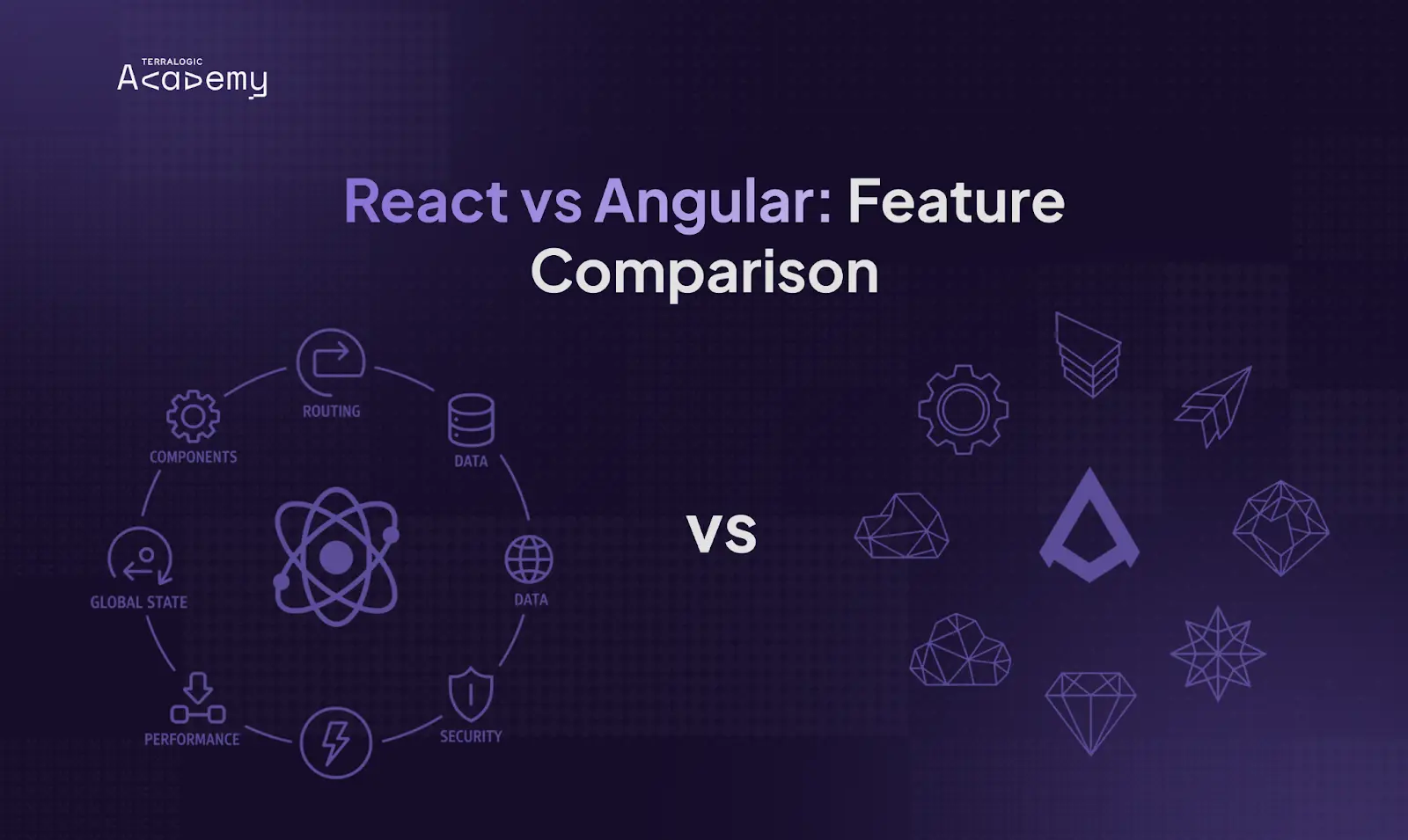
Both React and Angular are top picks for contemporary front-end development, but they handle web application development differently. React is appreciated for being simple and flexible, whereas Angular is renowned for having a structured, feature-complete framework.
React vs Angular at a Glance:
- React: A light-weight library centred around the view layer, best suited for building reusable components and dynamic UIs.
- Angular: An end-to-end frontend framework with built-in tools for routing, testing, and state management.
- React: More liberty by allowing developers to pick supporting libraries.
- Angular: Offers an all-in-one solution with a more opinionated design.
- React: Used popularly by React developers for startups to large enterprise web applications.
- Angular: Used for Angular web development in enterprise applications needing complex workflows.
React vs Angular: Which Is Better for Career Opportunities?
Both technologies can provide strong career opportunities.
React skills can be useful for roles such as:
- Front-End Developer
- React Developer
- JavaScript Developer
- UI Developer
- Full-Stack Developer
Angular skills can be useful for:
- Angular Developer
- Front-End Developer
- TypeScript Developer
- Web Application Developer
- Full-Stack Developer
Instead of focusing only on React vs Angular jobs, students should build strong JavaScript fundamentals and practical project experience.
React vs Angular: Which Is Better for Enterprise Applications?
Both React and Angular can be used for large-scale applications.
Angular may be particularly attractive to teams that want a structured framework with many capabilities integrated into the development environment.
React can be a strong choice for teams that prefer flexibility and want to select supporting technologies based on their application requirements.
The best choice depends on the organization’s architecture, team expertise, application requirements, and long-term maintenance strategy.
All topics




 HELP CENTER