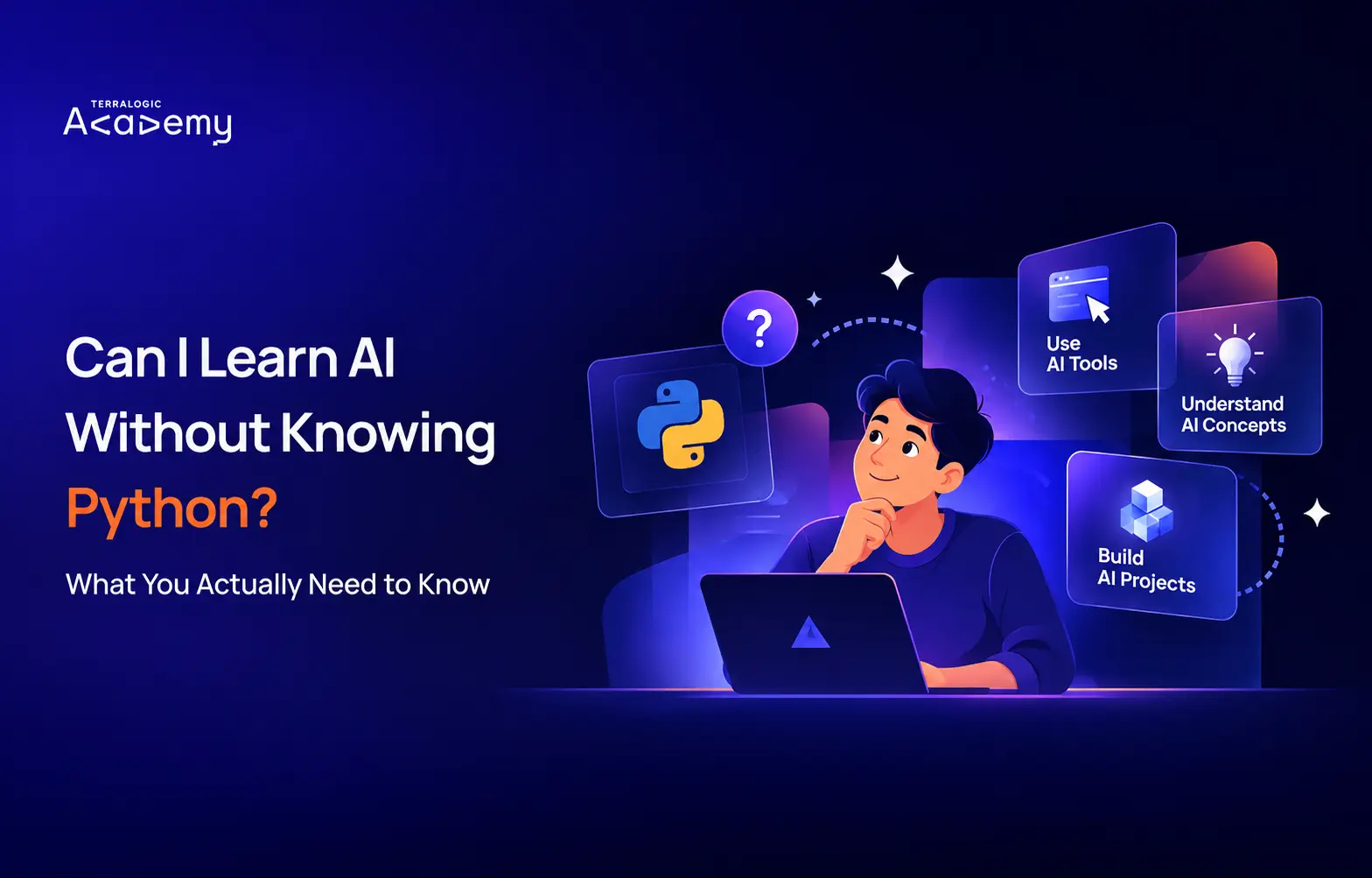
Can I Learn AI Without Knowing Python? What You Actually Need to Know
TL;DR
- Yes, you can start learning AI without Python. Concepts, AI tools, prompting and use-case discovery need no code.
- Python becomes necessary once you move from using AI to building, customizing and engineering AI systems.
- Python’s importance rises across 7 stages, from “not needed” in AI fundamentals to “core” in advanced AI engineering.
- Learn AI and Python together, through small projects: Learn → Build → Get Stuck → Solve → Understand → Build Again.
- Minimum Python to start: variables, data types, lists, dictionaries, conditions, loops, functions and imports.
Every AI roadmap says the same thing: “Learn Python.” That’s not wrong. But if you’re starting from zero, it raises a bigger question: do you need to learn Python before you even start learning AI?
Do You Need Python to Learn AI? The Short Answer
The short answer: no, not to start. But Python isn’t optional forever, either.
You can begin understanding AI, exploring AI tools, and identifying real-world use cases without touching a line of code. But the moment you move from using AI to building, customizing, evaluating, and engineering AI systems, programming stops being optional. Google’s own Machine Learning Crash Course recommends Python experience specifically because its exercises run on Python and flags NumPy, pandas, and basic statistics as useful prep.
So the real question isn’t “Do I need Python for AI?” It’s “At what stage does Python become important?”
What You Can Do in AI Without Python
Before writing any code, beginners can build real AI understanding and practical skills:
- Learn AI, ML and Generative AI concepts: free, non-technical courses such as Elements of AI explain how AI works without programming.
- Practise prompt engineering: use chat-based AI assistants to draft, summarise, analyse and compare outputs.
- Train simple models visually: tools like Google Teachable Machine let you train image or sound classifiers in the browser.
- Automate workflows with no-code AI tools: connect AI to everyday apps and processes without code.
- Evaluate AI outputs: learn to spot inaccurate, biased or ungrounded answers, a skill every AI role needs.
This is Stage 1 and Stage 2 of the map below. When you’re ready to go further, see our Artificial Intelligence course in Bangalore.
The 7-Stage Python Map: When Does Python Become Important for AI?
Python’s importance rises as you move from understanding AI to engineering it.
| Stage | Python Needed | What You’re Doing |
|---|---|---|
| 1. AI Fundamentals | No | Understanding AI/ML/GenAI concepts |
| 2. Experimentation | Not yet | Prompting, workflows, evaluation |
| 3. Python Foundations | Start | Variables, loops, functions, data structures |
| 4. Data & AI Programming | Rising | NumPy, pandas, JSON, APIs |
| 5. Machine Learning | Strong | Training, validation, evaluation |
| 6. AI Application Dev | Important | RAG, embeddings, app logic |
| 7. Advanced AI Engineering | Core | Pipelines, deployment, monitoring |
You don’t learn Python first and AI second; you learn them together, in step with what you’re actually trying to build.
Why Python specifically? It has become the default language for AI work. GitHub’s Octoverse 2024 report found Python overtook JavaScript as the most-used language on GitHub, driven largely by AI and data science projects.
The Loop That Actually Teaches You
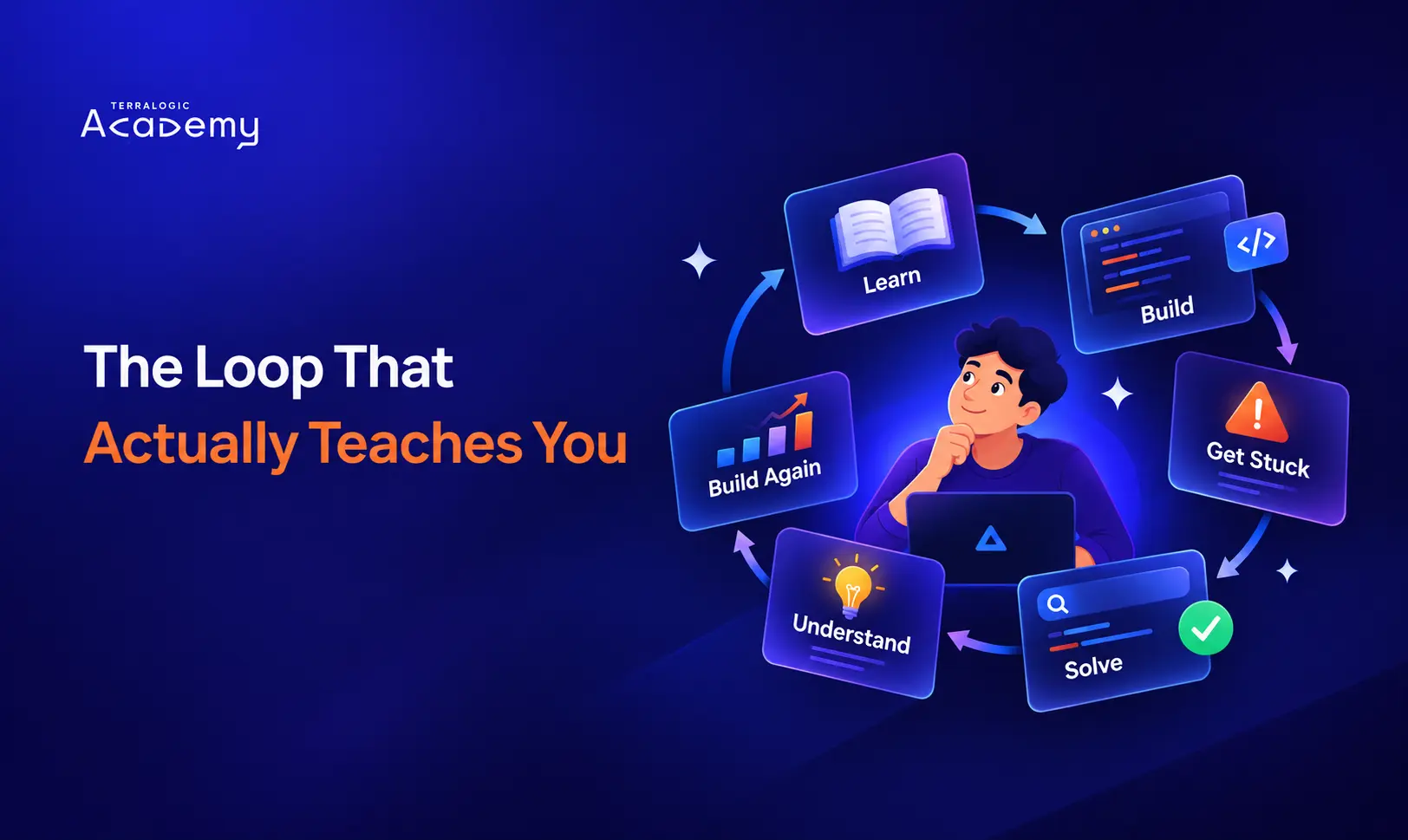
Most beginners think learning works like this: Learn → Learn more → Learn even more → Finally build something.
Real technical learning looks like this instead:
Learn → Build → Get Stuck → Solve → Understand → Build Again
You learn just enough to attempt the next step, not master a whole subject. You build something small with it immediately. You get stuck, and that’s not failure; that’s the actual learning signal. You search, debug, and solve it. Then the part that matters most: you understand why it broke in the first place, not just which line fixed it. That’s the shift from copying solutions to understanding systems. Then you build something slightly harder, and the loop repeats.
This is why project-based learning beats trying to memorize an entire language before touching a real problem. Every new concept gets a reason to exist.
FACT BREAKER: “I need to finish Python before I start AI.” Not true. Start with concepts and experimentation. Programming enters progressively as your goals get more technical; the mistake isn’t starting without Python, it’s believing you have to fully master one subject before touching the next.
Your Project Ladder: 5 AI Projects for Beginners
Don’t jump straight into a full AI system. Climb it.
1. Document Summarizer
PDF in, structured summary out. Teaches Python basics, file handling, API calls, and prompting.
2. Data Assistant
CSV in, insights out. Teaches pandas, data cleaning, and basic stats.
3. ML Prediction Model
Historical data in, a prediction out. Teaches feature prep, training, and validation. (scikit-learn is a common starting library.)
4. RAG Assistant
A knowledge base in context-aware answers. Teaches embeddings, retrieval, and vector search.
5. Real AI Application
A real user problem and a working app. Teaches architecture, evaluation, and deployment.
Each rung only requires the Python you need for that rung, not the whole language upfront.
What “Simple” Actually Takes
Say you want to build an AI assistant that reads company documents and answers questions from them. Sounds simple: “connect a document to an LLM.”
Then reality shows up.
- How does the app receive the files?
- How is the content extracted?
- How do you chunk large documents into usable pieces?
- How do you represent that content for retrieval embeddings?
- How does the system find the relevant piece?
- How does the model use that context to generate an answer?
- How do you know if the answer is actually grounded and correct?
- How does a real user interact with any of this?
That’s eight real questions hiding inside one “simple” idea, and it’s where AI concepts, Python, data handling, APIs, retrieval, and evaluation stop being separate topics and start being one connected system.
The Python Readiness Check: How Much Python Do You Need for AI?
Before going deeper into hands-on ML or AI development, ask if you can:
- Use variables, strings, numbers, booleans
- Work with lists and dictionaries
- Write if/else logic and loops
- Write a basic function and import a library
- Read/write a simple file and understand basic JSON
- Make a basic API request
- Load a CSV into pandas and inspect it
- Read a simple Python error and figure out what it’s telling you
You don’t need every box checked before starting AI. The list just tells you what to learn next.
Useful free references: the official Python tutorial and NumPy for absolute beginners.
How Long Does It Take to Learn Python for AI?
For most beginners practising consistently, the Python fundamentals in the readiness check above typically take a few weeks to a couple of months. Data libraries like pandas and NumPy, and then machine learning, come after that and are best learned through projects rather than on a fixed timeline. Your pace depends on weekly practice time, prior logic or maths exposure, and how quickly you start building.
| Phase | Focus | Matching Project |
|---|---|---|
| Python foundations | Syntax, data structures, functions, files, JSON | Document Summarizer |
| Data programming | pandas, NumPy, APIs, basic statistics | Data Assistant |
| Machine learning | Training, validation, evaluation | ML Prediction Model |
| AI application development | Embeddings, retrieval, app logic, deployment | RAG Assistant → Real AI Application |
So, Can You Learn AI Without Python?
Yes, but don’t read that as “Python doesn’t matter.” The accurate version: you can start learning AI without Python, but Python becomes increasingly important as you move from understanding and experimenting with AI toward building, customizing, and engineering it.
You don’t need to master Python before touching AI. You also shouldn’t avoid programming if your real goal is to build AI systems, not just use AI products.
Learn Python and AI Together, the Project-First Way
Terralogic Academy programs take you from AI fundamentals to building real AI applications, one project at a time.
People Also Ask
Can I learn AI without coding at all?
Yes, for understanding and using AI. You can learn AI concepts, use AI tools, write effective prompts, and automate tasks with no-code platforms. Building, customizing, or training your own AI systems, however, requires programming, most commonly Python.
Is Python hard to learn for beginners?
Python is widely considered one of the most beginner-friendly programming languages because its syntax is readable and close to plain English. The harder part for AI learners is usually data handling and debugging, which improves fastest through small projects.
Can a non-programmer become an AI engineer?
Yes, but it requires learning to program along the way. Many people start from non-technical backgrounds, begin with AI concepts and tools, then build Python, data and ML skills progressively through a structured project ladder.
Can I get an AI job without knowing Python?
Some AI-adjacent roles, such as AI product, prompt design, AI operations, or AI-enabled marketing and content, may need little or no coding. Roles that build or engineer AI systems, like ML engineer or AI developer, almost always expect Python.
Can AI tools write the Python code for me?
AI assistants can generate useful Python code, but you still need enough Python to read, test, debug, and judge whether that code is correct and safe. Understanding the code is what turns AI-generated snippets into working systems.
What math do I need for AI and machine learning?
To start, basic statistics, probability, and comfort with averages, percentages and graphs are enough. Linear algebra and calculus become more useful as you go deeper into how ML models are trained and optimized.
Frequently Asked Questions
Do I need Python before machine learning?
You don’t need it before understanding the concepts, but hands-on ML almost always involves programming, and Google’s ML Crash Course recommends Python for that reason.
How much Python is enough to start?
Variables, data types, lists, dictionaries, conditions, loops, functions, and imports. Add pandas, NumPy, and APIs once your projects need them.
Should I learn Python or AI first?
Neither fully before the other. Learn basic AI concepts, start Python fundamentals, and build both alongside increasingly complex projects.
Is Python the only language used in AI?
No, but it’s central to most ML and AI application workflows, which is why it’s the default starting point.
Which Python libraries should I learn first for AI?
Start with pandas and NumPy for data handling, then scikit-learn for classic machine learning. Learn a requests or API library for working with AI models, and add deep learning frameworks only when your projects need them.
Do I need SQL as well as Python for AI?
SQL is not required to start learning AI, but it is very useful in real projects because much business data lives in databases. Many learners add basic SQL alongside pandas.
Can I learn Python for AI online?
Yes. Free resources like the official Python tutorial and Google’s ML Crash Course cover the basics, while structured courses add a guided path, projects, and mentor feedback when you get stuck.
What is the first AI project I should build with Python?
A document summarizer is a strong first project: it takes a PDF and returns a structured summary, teaching Python basics, file handling, API calls and prompting in one small build.
Is it too late to start learning AI and Python?
No. AI tools and learning resources have made it easier than ever to begin. Starting with concepts, then adding Python step by step through projects, works at any career stage.
Keep learning: explore the Terralogic Academy AI course or browse more beginner guides on the Terralogic Academy blog.
All topics