
Top Prompt Engineering Tools for 2026: 10 Platforms Every AI Learner Should Know
The 2026 AI Learning Stack: 10 prompt engineering tools for the modern student.
The 10 AI platforms that will make your future boss hire you on the spot.
Why these 10 tools define the new era of “The AI Native” student
Don’t be a user. Be an engineer. The 10 AI tools you need to pivot
Let me start with a line I tell my students every year: “Great AI results are rarely accidental.”
In 2026, prompt engineering tools can reduce iterations needed for AI prompts by upto 90% in specific automated workflows. What once took hours of tweaking prompts manually can now be done systematically, measurably, and collaboratively.
When I began my tech career, we debugged code line by line. But today, we debug instructions. And just like software engineering evolved from notebooks to IDEs, prompt engineering has evolved from guesswork to professional tools. So, things are moving really fast.
In this blog, I’ll walk you through the top 10 prompt engineering tools for 2026, ranked and explained simply. This will help any AI learner, developer, or business professional to solve real market problems.
Prompt Engineering Basics for students
Before we dive into tools, let’s align with the fundamentals of prompt engineering.
Prompt engineering is the systematic design, testing, and optimization of instructions provided to Large Language Models (LLMs) like ChatGPT, Claude, and Gemini.
In 2026, effective prompting is no longer just about wording; it’s about workflow. The must-haves include:
- Prompt versioning: For tracking iterations.
- Testing and evaluation: For ensuring output quality.
- Multi-model support: For cross-platform flexibility.
- Performance tracking: For monitoring latency and cost.
- Team collaboration: For scaling internal knowledge.
By integrating these features, prompt engineering tools provide the structure, repeatability, and reliability. This is why prompt engineering tools beat manual prompting.
Key Features to Look for in Prompt Engineering
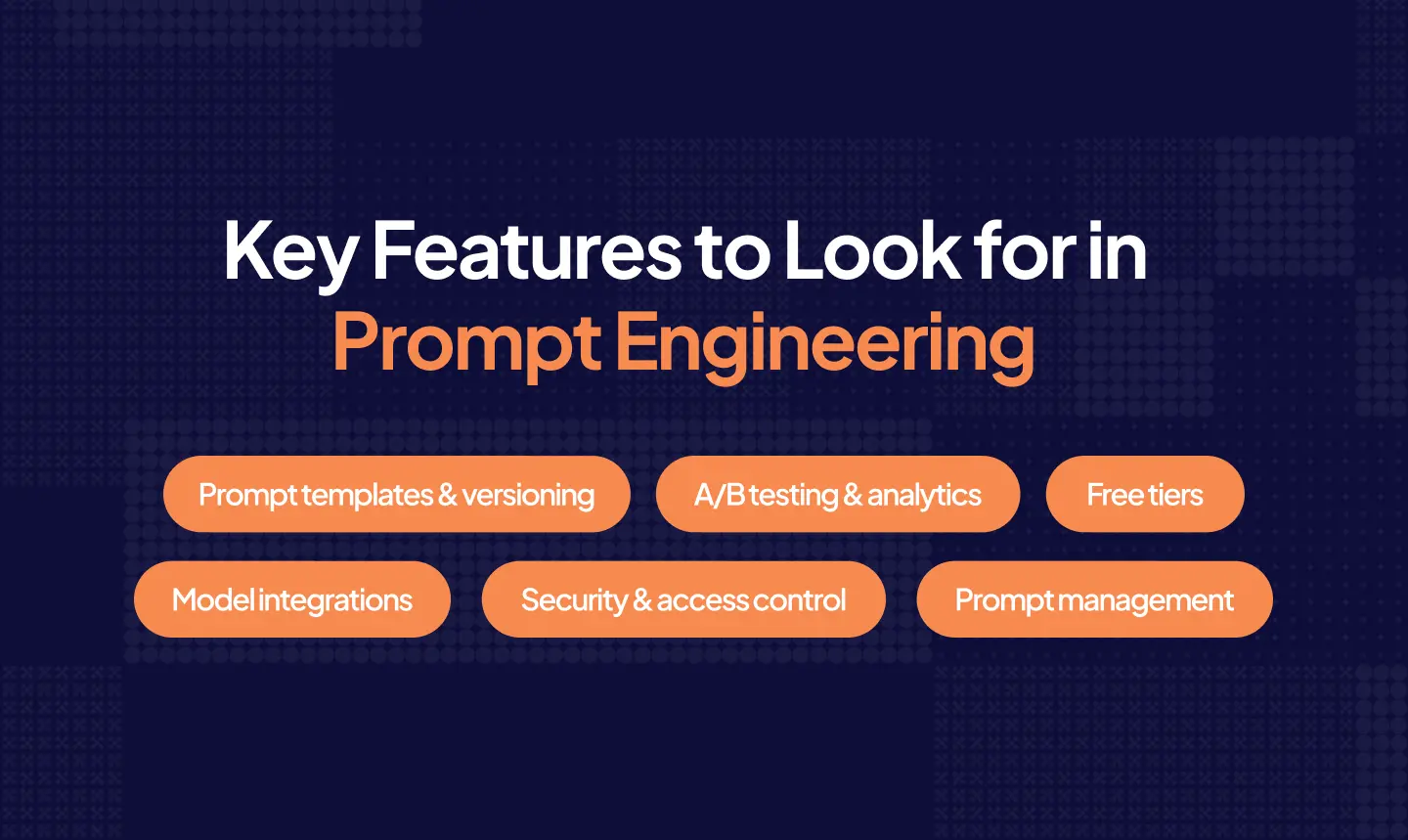
I ask my students to think like engineers, not consumers, when I teach them how to choose tools. You should always look for:
- Prompt templates & versioning: Track what changed and why
- A/B testing & analytics: Measure accuracy, cost, and latency
- Model integrations: ChatGPT, Claude, Gemini, open-source LLMs
- Prompt management: Libraries, reuse, rollback
- Security & access control: Especially for teams and enterprises
- Free tiers: Great for learners and experimentation
Top 10 Prompt Engineering Tools for 2026
I have grouped these tools by who they’re best for, just like I would do for my students:
Beginner-Friendly Prompt Engineering Tools
1. OpenAI Playground
Best for: Learning prompt basics
Why it matters: It’s the lab where most people start.
- Free prompt testing
- Parameter tuning (temperature, tokens, system prompts)
- Direct ChatGPT experimentation
Pricing: Free access; API usage $0.15–$2.50/₹12.50–₹208 per million tokens
Pros: Intuitive, fast learning curve
Cons: No versioning or collaboration
Rating: 4.8/5
2. PromptPerfect
Best for: Auto-optimizing prompts
Why it matters: Automatically rewrites prompts for better results
- Automatically rewrites prompts for better results
- Works with GPT and Claude
- Ideal for content and business users
Pricing: ~$20/month (₹1,660/month)
Pros: Saves time, no deep technical skills needed
Cons: Limited manual control
Rating: 4.6/5
Developer-Focused Prompt Engineering Tools
3. LangSmith
Best for: Developers using LangChain
Why it matters: Prompt debugging and evaluation.
- Prompt debugging and evaluation
- Trace errors across chains
- Free tier available
Why developers love it: You can see why a prompt failed.
Pricing: Free tier; paid starts at $39/month (₹3,250/month)
Pros: Deep tracing, integrates seamlessly
Cons: LangChain-focused
Rating: 4.7/5
4. Promptfoo
Best for: Open-source prompt testing
Why it matters: Compare prompts across models.
- Compare prompts across models
- Privacy-first, local testing
- Great for benchmarking
Ideal for: Teams that care about data control.
Pricing: Free (open-source); cloud $40/month (₹3,330/month)
Pros: Local privacy, model comparison
Cons: Setup required
Rating: 4.5/5
5. Mirascope
Best for: Python developers
Why it matters: Strong typing for prompts.
- Strong typing for prompts
- Reusable prompt components
- Cleaner LLM workflows
Teacher’s note: This tool feels like writing production-grade code—because it is.
Pricing: Free (open-source)
Pros: Type-safe, developer-friendly
Cons: Python-only
Rating: 4.4/5
Enterprise & Team Prompt Engineering Platform
6. Maxim AI
Best for: Enterprise-scale AI systems
Why it matters: Full prompt lifecycle management.
- Full prompt lifecycle management
- SOC2 compliant
- Monitoring, evaluation, and governance
Ideal for: Large businesses and regulated industries.
Pricing: Custom enterprise (~$100+/month or ₹8,300+/month)
Pros: Compliance-ready, scalable
Cons: Enterprise pricing
Rating: 4.7/5
7. PromptLayer
Best for: Version control & collaboration
Why it matters: Git-style prompt versioning.
- Git-style prompt versioning
- Track prompt performance over time
- Easy rollback
Think of it as: GitHub for prompts.
Pricing: Starts at $10/month (₹830/month)
Pros: Collaboration, versioning
Cons: Learning curve for teams
Rating: 4.6/5
8. Weights & Biases (W&B)
Best for: Experiment tracking
Why it matters: Deep analytics.
- Deep analytics
- Prompt + model performance insights
- Widely used in AI research
Great for: Teams optimizing at scale.
Pricing: Free tier; $50/month (₹4,160/month) for teams
Pros: Rich analytics, research standard
Cons: Overkill for simple prompts
Rating: 4.8/5
9. Langfuse
Best for: Observability & self-hosting
Why it matters: Self-hosted prompt tracking.
- Self-hosted prompt tracking
- Strong monitoring dashboards
- Open-source friendly
Perfect if: You want full control over your AI stack.
Pricing: Free self-host; cloud $20/month (₹1,660/month)
Pros: Full control, observability
Cons: Self-hosting setup
Rating: 4.6/5
10. Prompt Engine
Best for: Responsible AI & bias detection
Why it matters: Real-time feedback on prompts.
- Real-time feedback on prompts
- Bias and quality checks
- Enterprise-read
Why it stands out: Prompts don’t just need to work—they need to be ethical.
Pricing: Enterprise custom (~$50+/month or ₹4,160+/month)
Pros: Ethics-focused, quality assurance
Cons: Niche use case
Rating: 4.5/5
How to Choose the Right Prompt Engineering Tool
Here is the advice I give my students:
- Solo learners: Always start free (OpenAI Playground, Promptfoo) before you master.
- Developers: You should choose tools with testing and debugging
- Businesses: Your priority should be analytics, security, and collaboration
- Evaluate metrics: Always evaluate metrics like accuracy, latency, and cost per prompt
- Test before scaling: Never commit blindly. Always understand and get to know first.
Best Practices for Using Prompt Engineering Tools
- You should treat prompts like code, not text
- Remember, always version before changing prompts
- Don’t forget to test prompts across multiple models
- Always measure output quality, not just speed
- Reuse templates for consistency
- Collaborate and review prompts like pull requests
All topics



 HELP CENTER