
Vue vs React in 2026: Which Framework is Best for Scalable Web Apps?
Angular’s GitHub repo shows 1.7 million, React currently shows almost 5.7 million users, while Vue shows over 167,000 for both of its repos combined. Quite a difference among the three frameworks, but this is largely due to Vue being the newer framework and doesn’t tell the full picture on overall demand.
Vue vs. React in 2026 will be more than just a choice. This one choice can shape how scalable, stable, and future-ready your web apps can be. Although Vue and React frameworks have matured into powerful ecosystems, offering speed, flexibility, and a strong community, an ongoing debate.
There are requirements for high-performance applications and tighter test automation workflows. Picking the correct front-end technology will impact everything from development velocity to long-term maintenance. This blog breaks down how each framework performed in 2006. It will also help you decide which one truly fits the needs of modern, scalable web applications.
Understanding the Core of React and Vue Frameworks
React.js is one of the leading JavaScript UI frameworks known for component reusability, virtual DOM performance, and ecosystem support. It is ideal for dynamic single-page applications (SPA) and excels in large web app development. It automates website testing and accessibility testing for website setup. For enterprises evaluating the React framework vs. the Vue framework, React remains a robust, scalable choice.
What is Vue?
Vue is a progressive and lightweight front-end development framework, usually admired for simplicity and speed. It streamlines development while supporting different things. These can be mobile app testing, clean architecture, and smooth scalability. Developers comparing Vue vs. React often opt for Vue, as it features a more intuitive design and offers rapid build efficiency.
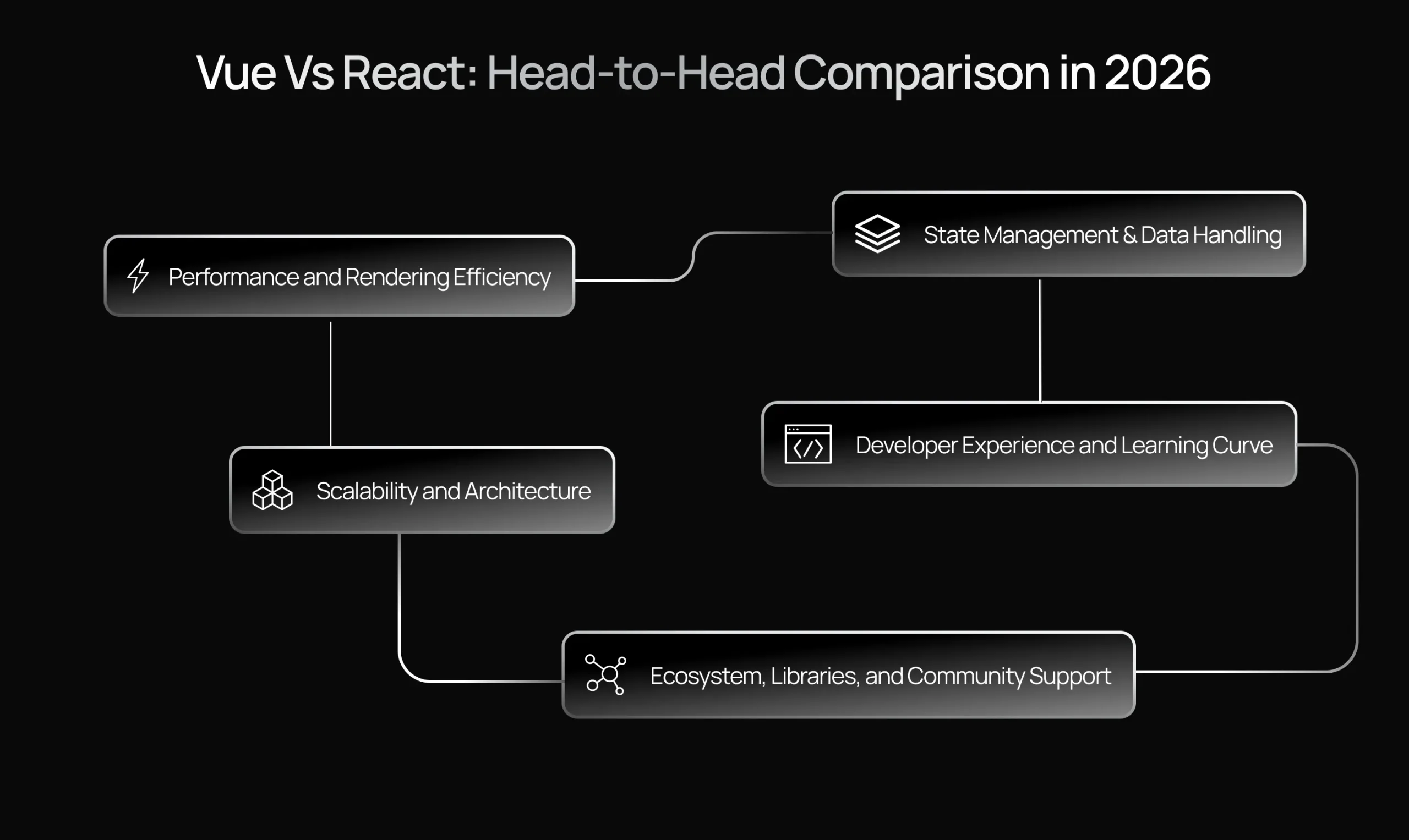
When it comes to choosing the right JavaScript framework in 2026, understand how Vue and React are different. If you are planning to build SPAs’ enterprise dashboards or mobile-first interfaces, these differences will always help your teams decide when to use Vue vs. React and which is better for long-term growth. Below is a focused comparison across the core technical pillars:
Performance and Rendering Efficiency
- React.js offers highly optimized virtual DOM rendering. This makes it ideal for complex UI updates and high-traffic apps.
- Vue.js utilizes a lightweight virtual DOM, plus compiler optimizations. It delivers fast initial loads and smooth transitions.
- Vue performs better for small-to-medium SPAs, whereas React handles large, interactive apps more consistently.
- They both support performance profiling and seamless website testing for rendering bottlenecks.
- React edges ahead for apps that require advanced rendering patterns, like concurrent UI or heavy animations.
Scalability and Architecture
- The React framework follows a flexible, unopinionated architecture, allowing teams to build custom, scalable structures.
- Vue provides more built-in conventions, making it easier to maintain consistency in growing teams.
- React’s modularity benefits enterprise-level systems with multiple micro-frontends.
- Vue 3’s Composition API improves scalability but still leans toward guided patterns.
- Both frameworks support scalable front-end architectures suited for evolving product roadmaps.
Developer Experience and Learning Curve
- Vue.js is beginner-friendly with simple templates and intuitive syntax, making it a popular choice for learners starting a front-end development course or teams aiming for faster onboarding.
- React.js requires understanding JSX, hooks, and functional patterns, giving it a slightly steeper learning curve.
- Vue accelerates early-stage development; React supports more complex, customizable engineering workflows.
- React’s active community produces richer documentation for advanced patterns.
- Both offer strong app testing and mobile app testing setups, especially with Jest and Cypress.
State Management & Data Handling
- React relies heavily on external solutions like Redux, Zustand, or Recoil for large-scale state handling.
- Vue ships with Pinia (and previously Vuex). It offers a smoother, integrated state management experience.
- React provides more diversity; Vue provides more simplicity and structure.
- For enterprise SPAs with heavy real-time data, React’s ecosystem offers more optimization tools.
- Vue’s reactivity system remains cleaner and easier to debug for mid-scale applications.
Ecosystem, Libraries, and Community Support
- React leads with the largest ecosystem among modern UI frameworks, offering unmatched third-party libraries.
- Vue continues to grow with stable tooling like Vue Router, Pinia, and Nuxt for full-stack development.
- React’s global community ensures faster troubleshooting and richer plugin availability.
- The community of Vue is tight-knit, supportive, and ideal for teams that value consistency.
- Both frameworks integrate smoothly with automation tools used for accessibility testing websites, end-to-end testing, and CI/CD workflows.
Vue 3 Vs React 19: What’s New in 2026
There is no doubt that both Vue 3 and React 19 have evolved into powerful next-gen JavaScript frameworks. Both are built for high performance, test-friendliness, better developer experience, and stronger tooling for web app development and app testing. They are also known for enterprise front-end architecture. Here’s what’s new:
Major Updates in React 19
- Faster server components enable smoother data fetching and rendering.
- Automatic batching enhancements for improved UI responsiveness in large SPAs.
- Smaller bundle sizes with better tree-shaking for performance optimization.
- Improved React compiler reducing manual optimization work for developers.
- Stronger devtools integration for debugging and state inspection.
- Better support for modern test automation, accessibility checks, and scalable workflows.
- Enhanced architectural patterns ideal for micro-frontends and enterprise React ecosystems.
Major Updates in Vue 3
- You get an improved reactivity system with faster tracking and reduced overhead.
- A smaller runtime core results in quicker load times and lightweight builds.
- An enhanced composition of the API offers cleaner, more maintainable logic structures.
- Better TypeScript Support aligned with large-scale project needs.
- The Nuxt 4 advancements are empowering full-stack and SSR experiences.
- Enhanced native features reduce dependency on external libraries.
- A smoother website testing, component testing, and debugging workflows for teams.
If you are enrolling in a front-end development course, look for these points, as they are crucial for your coding journey.
Use Cases: When to Choose Vue and When to Choose React
When choosing between Vue and React, consider team size and product complexity. Consider testing requirements and long-term scalability needs when choosing one for business. Here’s a quick breakdown to help decide when to use Vue vs. React, especially for SPAs, dashboards, and modern UI builds:
Vue.js is Better For
- Simple syntax and a gentle learning curve
- Rapid MVPs, mid-scale SPAs, and clean UI-driven apps
- When your projects need built-in conventions and structured architecture
- Faster onboarding for junior or mixed-skill teams
- Apps where lightweight bundles and quick rendering matter most
- Use cases require fewer external libraries and easier maintenance
React is Better For
- Large, complex apps with multiple integration layers
- I want enterprise systems, dashboards, and long-term product roadmaps
- When your teams require maximum flexibility and custom architecture
- If your applications rely on heavy user interactions or dynamic UIs
- Projects needing a massive ecosystem, community, and tooling support
- Robust workflows for app testing, automation, and accessibility testing
Future Outlook: Vue Vs React in the Coming Years
These days, front-end ecosystems are continuously shifting towards AI-assisted development, micro-frontends, and performance-first architecture. Both Vue and React are positioned to remain dominant players. React will likely continue leading enterprise-scale innovation due to its vast ecosystem and long-term corporate backing. Talking about Vue will strengthen its position as a developer-friendly, efficient, and highly adaptable framework.
Both frameworks are expected to expand their tooling for automated workflows, accessibility testing, and advanced performance optimization. This makes them a future-proof choice for evolving digital products.
All topics




 HELP CENTER