How to Start a Career in AI the Right Way (And Avoid the Beginner Mistake)

Here’s what happens to 9 out of 10 AI beginners: They watch a YouTube tutorial on neural networks on Monday. Build a “model” in Jupyter on Tuesday. By Wednesday, they’re convinced they’re ready for an AI job.By next month? Frustrated. Overwhelmed. Quit.
How to start a career in AI isn’t complicated. But it’s also not what most people think. The mistake isn’t stupidity—it’s structure. Most beginners jump straight into advanced concepts, chase tools instead of understanding, and follow hype instead of fundamentals.
The result? They burn out before they even start.
Let me show you exactly where beginners go wrong, why it happens, and the actual step-by-step path to break into AI without the noise.
The Most Common Beginner Mistake in AI
You know what kills AI careers before they start?
Jumping into advanced concepts without building foundations.
Beginners see “neural networks” trending on Twitter, jump to PyTorch, build something that kind of works, then wonder why they can’t explain what their model actually does. They memorize code instead of understanding concepts.
The second mistake? Chasing tools instead of concepts. “Should I learn TensorFlow or PyTorch?” “Do I need Spark?” “What about LLMs?” They’re asking the wrong question entirely.
The third? Following hype-based learning instead of structured learning. Social media screams “Learn Prompt Engineering!” or “Become a Data Scientist in 30 days!” Beginners follow the noise, jump between topics weekly, and never build depth.
Result: Scattered knowledge. No portfolio. No job.
Why This Happens
Misleading social media advice makes it sound easy. “I learned AI in 3 months!” isn’t telling you about the 500 hours of work behind it or the prior programming experience.
Overdependence on ChatGPT and tutorials makes beginners think understanding = having access to the internet. They can prompt an AI to write code but can’t explain why it works.
Not understanding what AI roles actually require leads to learning random skills instead of targeted ones. Entry-level roles need different skills than senior roles. Most beginners don’t know the difference.
Lack of a step-by-step career plan means they’re flying blind. No roadmap. No milestones. Just hoping something clicks.
What You Actually Need to Start a Career in AI
1. Foundational Skills (This Cannot Be Skipped)
Python: Not just syntax. Actual fluency. Know libraries (NumPy, Pandas) deeply.
Math: Linear algebra, probability, statistics. Yes, all three. This is non-negotiable for understanding why models work.
Data structures & algorithms: Not for coding interviews (though that helps). For building efficient systems.
Data cleaning: 80% of real AI work. Most tutorials skip this.
2. Practical Machine Learning
Understand ML model types (classification, regression, clustering)
Know evaluation metrics (accuracy isn’t enough—understand precision, recall, F1)
Understand overfitting/underfitting (this kills most beginner models)
Learn ML pipelines (train/test split, cross-validation, hyperparameter tuning)
3. Hands-On Projects
Build real projects. Kaggle beginner datasets. Predictive models. NLP or computer vision starter projects. Make them reproducible. Push to GitHub.
Theory + projects = employable.
Step-by-Step Guide: How to Start a Career in AI the Right Way

Step 1: Build Strong Foundations (Months 1-2)
Learn Python properly. Not “I can copy-paste code.” Actually learn it. Then hit math fundamentals. Linear algebra for matrices, probability for distributions, statistics for data interpretation.
The AI learning path starts here. Skip this, and everything else falls apart.
Step 2: Learn ML and Deep Learning Basics (Months 2-3)
Now learn supervised learning (regression, classification), unsupervised learning (clustering), and evaluation metrics. Understand the math behind it, not just the code.
Then move to deep learning basics (neural networks, forward/backward propagation).
Step 3: Create Mini-Projects (Months 3-4)
Build 3-4 beginner projects using Kaggle datasets. Predicting house prices. Iris classification. MNIST digits. Make them work end-to-end.
AI skills for beginners solidify through doing.
Step 4: Build Your AI Portfolio (Month 4-5)
Push all projects to GitHub with clear documentation. Write medium articles explaining what you built and why. Build reproducible notebooks. Quality > quantity.
Your portfolio is your resume in AI.
Step 5: Choose Your Career Track
- ML Engineer: Building production systems. Needs system design + ML.
- Data Scientist:Insights + modeling. Needs statistics + business sense.
- NLP Engineer: Natural language processing. Specific + high-demand.
- Computer Vision Engineer: Image/video processing. Growing rapidly.
- AI Research:Advanced theory. Typically needs an advanced degree.
- AI Product Analyst:AI + product management hybrid.
Pick one. Go deep.
Step 6: Learn Essential Tools
Scikit-learn (classical ML), TensorFlow or PyTorch (deep learning), SQL (data querying), cloud basics (AWS/GCP).
Don’t learn everything. Learn what your chosen track needs.
How to Avoid the AI Beginner Mistake
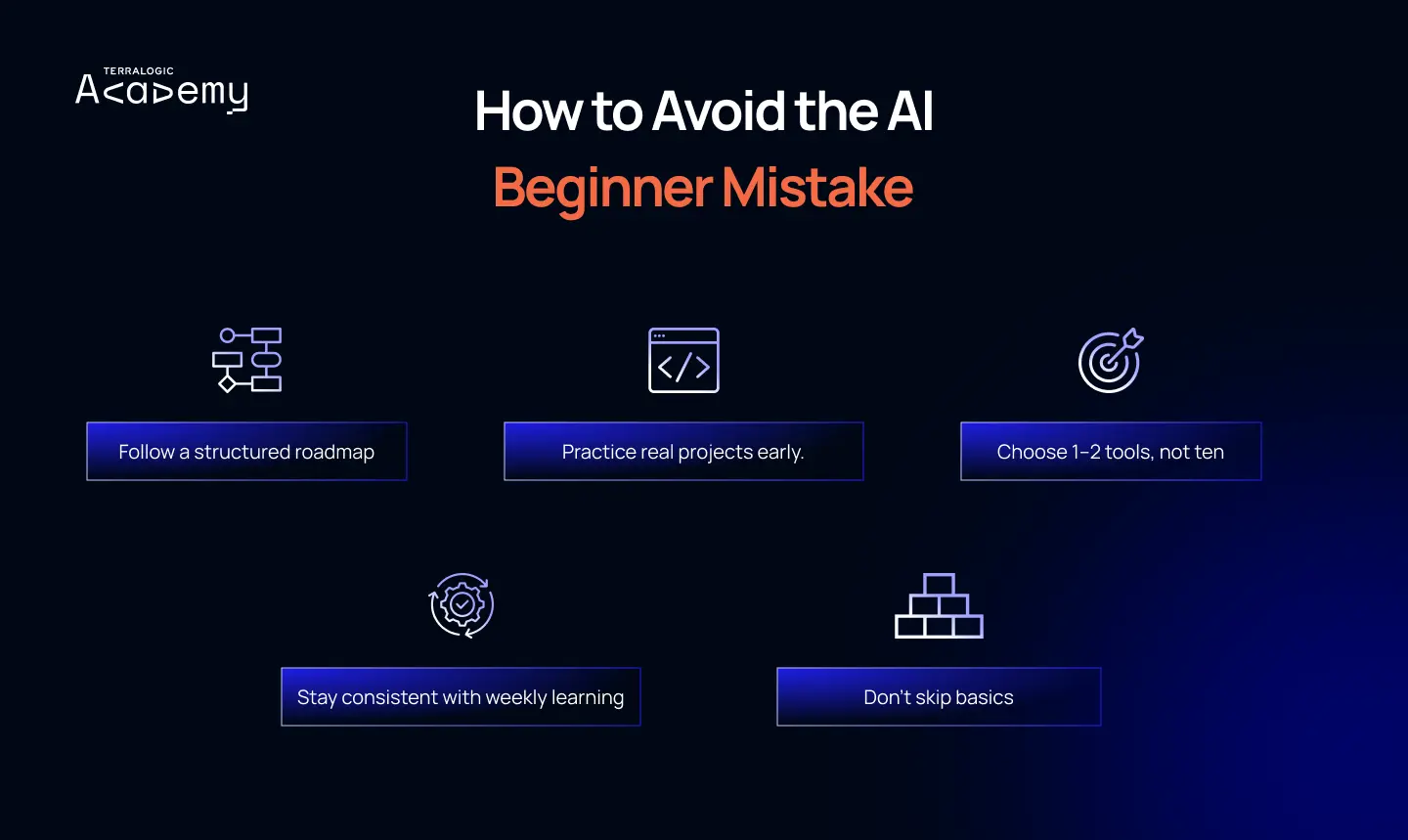
Follow a structured roadmap. Not random YouTube videos. Structured curriculum (Andrew Ng’s ML course, Fast.ai, etc.).
Don’t skip basics. Foundations feel boring. They’re not optional.
Choose 1–2 tools, not ten. Master TensorFlow or PyTorch. Not both initially. Not TensorFlow + PyTorch + JAX.
Practice real projects early. Theory-only learning fails. Build while learning.
Stay consistent with weekly learning. 10 hours/week for 12 months beats 40 hours/week for 3 months then quit.
Additional Tips for a Strong AI Career Start
- Join AI communities: Reddit r/MachineLearning, Discord servers, local meetups
- Read research summaries:Not full papers initially. ArXiv summaries, Papers With Code
- Build a niche specialization:“ML engineer” is generic. “NLP engineer focused on text classification” is hireable
- Update your portfolio monthly: Show active learning and projects.
- Apply for internships and freelance ML tasks:Real experience matters
All topics



 HELP CENTER