TL;DR
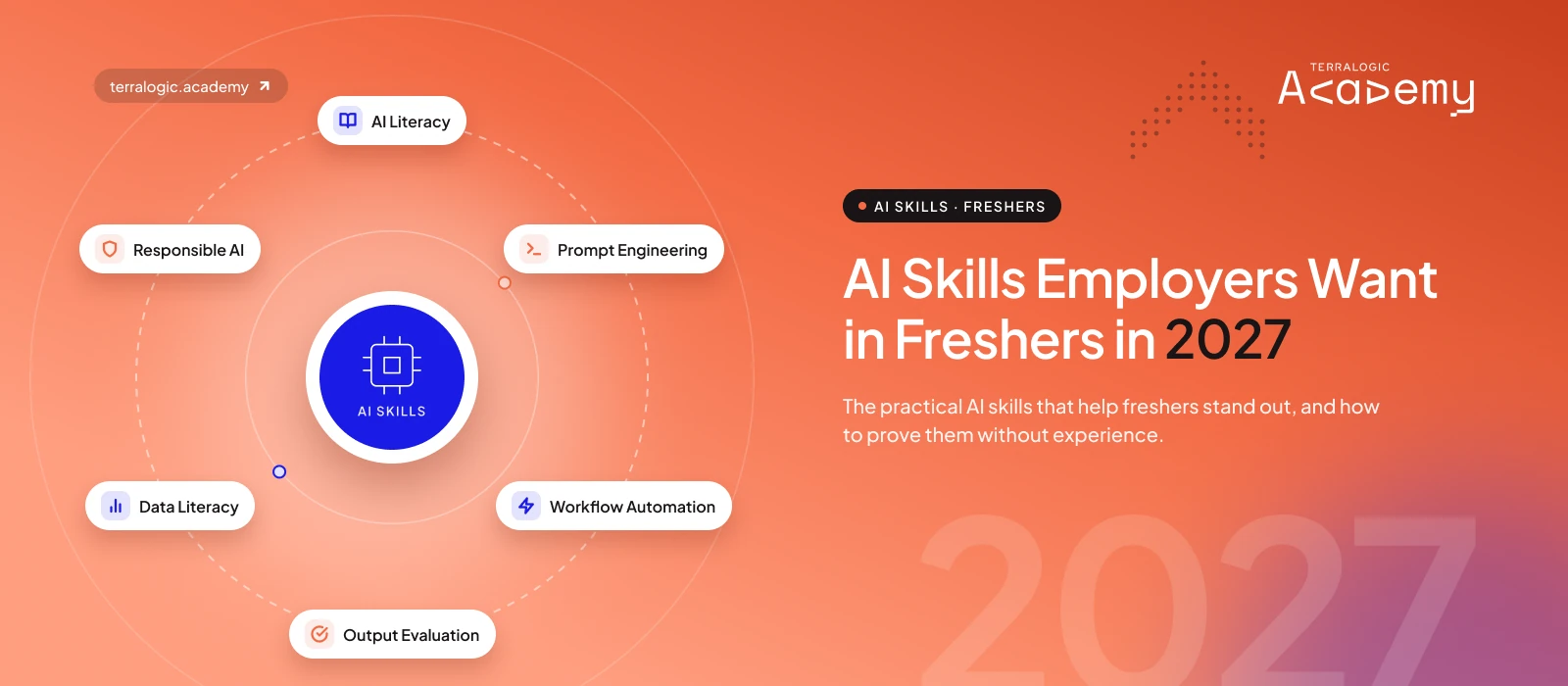
- Employers look for AI literacy, prompt engineering, workflow automation, data analysis, critical thinking, and responsible AI use.
- Technical roles additionally require Python, SQL, machine learning, and AI development fundamentals.
- The gap is practical application: a portfolio shows what you can do.
- Use the Problem → AI → Verification → Outcome framework to structure each project.
- The right AI skills for jobs are the ones that match the work you want to do.
Learning to use ChatGPT is easy. Knowing when to use it, how to verify its answers, and how to solve a real workplace problem? That’s a different skill altogether.
Many freshers are learning AI tools, completing certifications, and adding them to their resumes. Yet when employers ask them to demonstrate what they can actually build or improve using AI, they struggle.
The gap is practical application.
If you’re preparing for your first job in 2027, understanding which AI Skills matter for your chosen career can help you focus on the right things instead of learning every trending tool.
Quick Answer: What AI Skills Do Employers Want in Freshers in 2027?
Employers look for AI literacy, prompt engineering, workflow automation, data analysis, critical thinking, and responsible AI use. Technical roles additionally require Python, SQL, machine learning, and AI development fundamentals. Employers increasingly value candidates who can apply these skills to real problems and demonstrate reliable results.
Why Are AI Skills Important for Freshers in 2027?
AI is changing what companies expect from entry-level employees. AI tools can now assist with tasks that once involved manual research, data processing, and routine documentation.
According to Deloitte India’s Campus Workforce Trends 2026, 35% of surveyed organisations reported that AI adoption was creating new entry-level roles or skill requirements, up from 21% in FY25.
A separate Cognizant–Pearson study published in June 2026 reported that AI was performing an estimated 37% of entry-level tasks in India, based on a survey of HR leaders.
What does this mean for you?
Companies increasingly need employees who can work alongside AI, evaluate its outputs, and make informed decisions. Your subject knowledge still matters, but knowing how to apply it with AI can strengthen your job readiness.
What Are the Most Important AI Skills Every Fresher Should Learn?
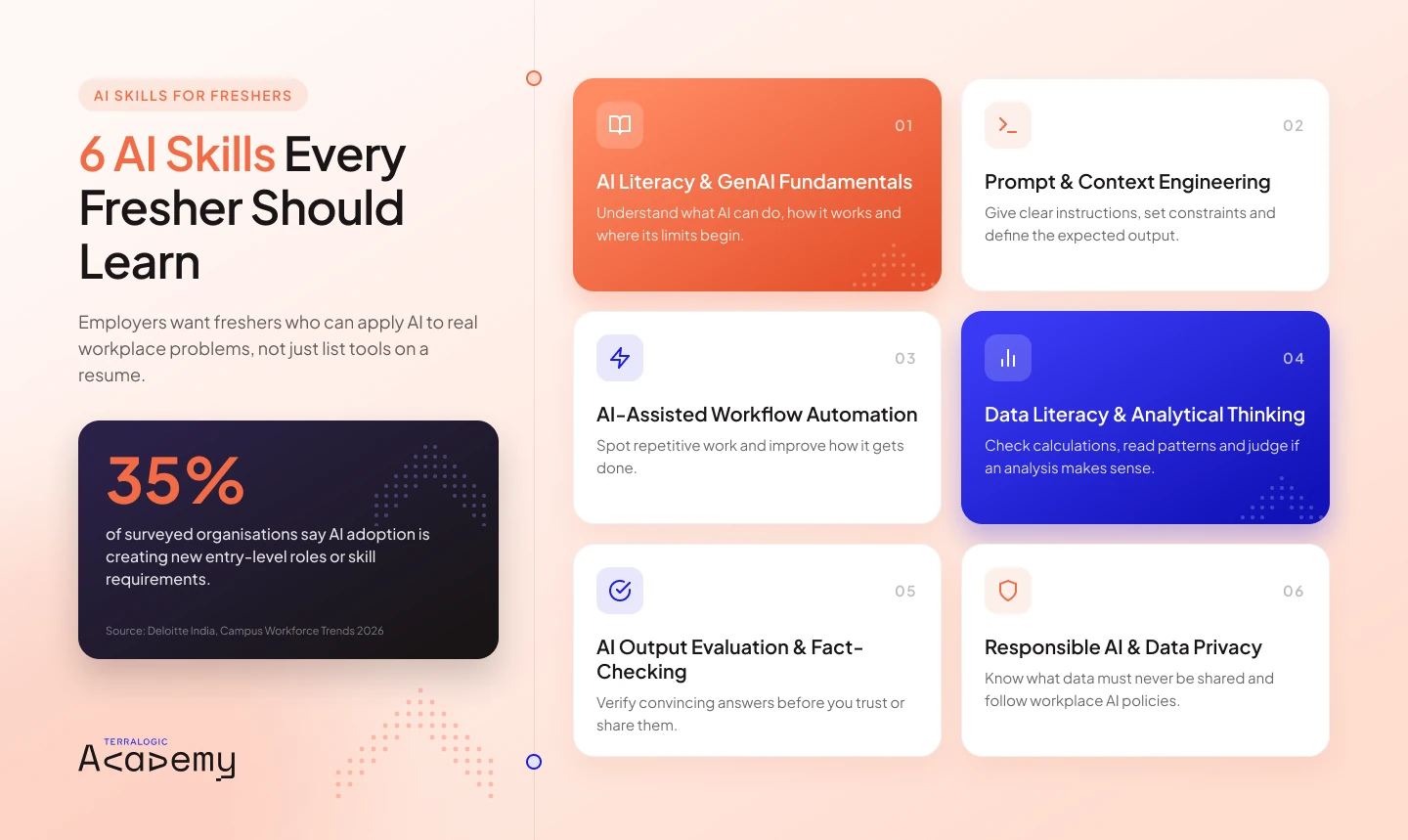
The most useful AI skills for students are those that improve everyday work, regardless of the career they choose.
| AI Skill | What It Means |
|---|---|
| 1. AI Literacy and Generative AI Fundamentals | Understanding what AI can do, how it works at a basic level, and where its limitations begin |
| 2. Prompt Engineering and Context Engineering | Giving clear instructions and supplying relevant background information, examples, and reference material |
| 3. AI-Assisted Workflow Automation | Identifying repetitive work and improving how it gets done |
| 4. Data Literacy and Analytical Thinking | Understanding datasets, identifying patterns, checking calculations, and interpreting results |
| 5. AI Output Evaluation and Fact-Checking | Identifying unsupported claims and verifying information |
| 6. Responsible AI and Data Privacy | Understanding what information should not be shared with AI |
1. AI Literacy and Generative AI Fundamentals
AI literacy means understanding what AI can do, how it works at a basic level, and where its limitations begin.
You should understand:
- The difference between AI, machine learning, and Generative AI.
- How large language models (LLMs) generate responses.
- Common AI applications in business.
- Why AI-generated answers can contain errors.
For example, you might use ChatGPT to summarise customer reviews. But understanding AI means knowing that its summary should be checked against the original reviews.
Where to start: Experiment with ChatGPT, Gemini, or Claude using everyday tasks and compare the results.
2. Prompt Engineering and Context Engineering
Knowing how to ask AI the right questions is more useful than memorising complicated prompts.
Prompt engineering involves giving clear instructions, defining the task, setting constraints, and specifying the expected output.
Context engineering goes further by supplying relevant background information, examples, and reference material.
Consider two instructions:
| Basic Prompt | Improved Prompt |
|---|---|
| Analyse this sales data. | Analyse this monthly sales dataset, identify the three largest changes, explain possible reasons supported by the data, and present the results in a table. |
The second instruction makes the task clearer and the output easier to evaluate.
Practice: Create reusable prompts for research, reporting, coding, or documentation.
3. AI-Assisted Workflow Automation
Employers value people who can identify repetitive work and improve how it gets done.
AI-assisted automation can help with:
- Organising customer queries.
- Classifying feedback.
- Preparing recurring reports.
- Summarising approved documents.
For instance, instead of manually sorting 100 customer comments into categories, you could create an AI-assisted workflow to classify them and review the results.
Start with simple automation tools before attempting complex systems.
4. Data Literacy and Analytical Thinking
AI can analyse large datasets, but someone must determine whether the analysis makes sense.
Data literacy involves understanding datasets, identifying patterns, checking calculations, and interpreting results.
Start with Excel or Google Sheets before moving into SQL, Python, or Power BI where your career requires them.
Practice: Analyse a sample sales dataset, identify trends, and explain what the numbers actually support.
5. AI Output Evaluation and Fact-Checking
An AI-generated answer that sounds convincing isn’t necessarily correct.
Freshers should know how to:
- Identify unsupported claims and hallucinations.
- Verify information using credible sources.
- Review AI-generated code and calculations.
- Recognise incomplete or biased conclusions.
Suppose an AI tool generates a market research report containing industry statistics. Before using those figures, verify their sources, dates, and relevance.
The ability to catch an AI mistake is often more useful than generating another answer.
6. Responsible AI and Data Privacy
Using AI professionally also means understanding what information should not be shared with it.
Learn the basics of confidential data handling, copyright, privacy, and workplace AI policies.
For example, uploading customer contact details or confidential company documents to an unapproved public AI tool could create security and privacy risks.
REMEMBER: Responsible AI use is part of professional judgment, not an optional technical specialisation.
Which AI Technical Skills Do Employers Expect From Freshers?
If you’re pursuing software development, data science, or AI engineering, general AI literacy won’t be enough.
You’ll need additional AI technical skills that help you build, test, and maintain applications.
Python Programming and SQL
Python is widely used for automation, data processing, and AI application development. SQL helps you retrieve and manage information stored in databases.
Start with Python variables, functions, loops, data structures, and basic libraries such as Pandas and NumPy. Then learn SQL queries, joins, filtering, and aggregation.
According to Foundit’s analysis of AI hiring in India in 2025, Python appeared in nearly 75% of AI job roles, while SQL and data engineering skills appeared in over half. These figures cover roles across experience levels, not only freshers.
Machine Learning Fundamentals
Strong machine learning skills begin with understanding how models learn from data.
Focus on:
- Supervised and unsupervised learning.
- Regression, classification, and clustering.
- Training and testing datasets.
- Model evaluation using accuracy, precision, and recall.
Don’t stop after training a model. Learn how to clean the dataset, interpret its predictions, and identify errors.
For deeper guidance, read Why Knowing ML Algorithms Isn’t Enough to Build Real Projects.
Generative AI, RAG, and AI Agents
These are useful areas to explore after developing your programming and data fundamentals.
Retrieval-Augmented Generation (RAG) allows an AI application to retrieve relevant information from external knowledge sources before generating an answer.
For example, a RAG-based assistant could answer questions using an approved collection of company policy documents.
AI agents go further by using tools and performing multi-step tasks under defined controls.
You don’t need to master advanced agentic systems immediately. Start by understanding AI APIs, document retrieval, tool calling, and output evaluation.
Git, Cloud Computing, and Deployment
Your AI development skills should also include the basics of delivering usable software.
Learn Git and GitHub for version control, explore a cloud platform such as AWS or Azure, and understand application testing and deployment.
A working application with documentation demonstrates more than an unfinished notebook.
Build Technical AI Skills: Explore the Course →
What Human Skills Do Employers Value Alongside AI?
AI tools can generate suggestions, but your ability to evaluate and apply them remains important.
Four skills deserve particular attention.
| Human Skill | What It Means |
|---|---|
| Critical thinking | Analyse problems, challenge assumptions, and make decisions rather than accepting AI recommendations blindly. |
| Communication | Explain technical information clearly to colleagues, managers, and customers. |
| Adaptability | Learn unfamiliar tools and adjust when technologies or workplace requirements change. |
| Ownership | Take responsibility for the complete task, including identifying problems, testing solutions, and delivering results. |
These capabilities complement your technical knowledge. Deloitte India’s 2026 campus study also identified learning agility, adaptability, collaboration, and role-specific skills as increasingly important in hiring.
How Do AI Skill Requirements Differ Between Technical and Non-Technical Freshers?
The AI skills needed for entry-level jobs depend on the responsibilities of each role.
| Skill Area | Technical Freshers | Non-Technical Freshers |
|---|---|---|
| Core focus | Building and integrating AI systems | Using AI to improve business tasks |
| Programming | Python, SQL, APIs | Usually optional |
| AI knowledge | ML, LLMs, RAG | AI literacy and prompting |
| Automation | Code-based workflows | Business and no-code workflows |
| Evaluation | Testing, debugging, model quality | Fact-checking, business accuracy |
| Human skills | Problem-solving, collaboration | Communication, judgment |
For example, an aspiring AI engineer may need Python, SQL, and machine learning. A marketing fresher may benefit more from AI-assisted research, data interpretation, and content verification.
The right AI skills for jobs are the ones that match the work you want to do.
Where Can Freshers Apply AI Skills in Different Careers?
You don’t need to become an AI engineer to benefit from AI.
| Career Path | Relevant Skills | Practical Project |
|---|---|---|
| Software development | Python, APIs, debugging | AI-assisted web application |
| Data analytics | SQL, Python, visualisation | Sales analysis dashboard |
| Digital marketing | Prompting, research, evaluation | AI-assisted content research |
| HR | Data handling, AI literacy, privacy | Anonymised feedback analysis |
| Finance | Data validation, automation | Expense categorisation tool |
| Operations | Workflow automation | Automated reporting workflow |
| AI engineering | ML, RAG, APIs | Document-question-answering assistant |
Choose projects that demonstrate skills relevant to the responsibilities listed in actual job descriptions.
How Can Freshers Prove Their AI Skills Without Experience?
Listing ChatGPT, Python, or machine learning on your resume tells employers what you’ve studied.
A portfolio shows what you can do.
Build Two or Three Practical Projects
Choose projects that solve clearly defined problems. They don’t need to be complicated, but they should work reliably.
For example, a beginner could build a customer-feedback analyser that groups reviews by topic, identifies recurring complaints, and produces a checked summary.
Use the Problem–AI–Verification–Outcome Framework
Structure each project around four questions.
Problem → AI → Verification → Outcome
| Stage | What to Demonstrate |
|---|---|
| Problem | What issue were you trying to solve? |
| AI | Which tools or methods did you use? |
| Verification | How did you check accuracy? |
| Outcome | What did the project achieve? |
Include your code, sample data, screenshots, limitations, and documentation where appropriate.
If you claim that your project reduced processing time, show how you measured it.
Prepare to Explain Your Work
Employers may ask why you chose a particular tool, how you handled incorrect outputs, and what you would improve.
If you cannot explain the code or decisions behind your project, it becomes difficult to demonstrate genuine competence.
Build AI Projects With Mentor Support →
How Can Freshers Learn AI Skills in 90 Days?
You don’t have to learn everything at once. Follow a structured path based on your career goals.
| Timeline | Learning Focus | Expected Output |
|---|---|---|
| Days 1–15 | AI literacy and fundamentals | Complete basic AI tasks |
| Days 16–30 | Prompting and fact-checking | Build a verified workflow |
| Days 31–45 | Data literacy and role-specific basics | Analyse a sample dataset |
| Days 46–60 | Python/SQL or business automation | Complete a mini-project |
| Days 61–75 | Portfolio development | Build and document a project |
| Days 76–90 | Resume and interview preparation | Present your project clearly |
This is a starting roadmap, not a guarantee that you can master AI engineering in three months. Advanced technical careers require deeper study and continued practice.
For a more detailed plan, follow our three-month AI roadmap for beginners.
What AI Skills Do Employers Test During Fresher Interviews?
Interviewers may evaluate your ability to apply AI, not just define terminology.
Prepare for practical questions such as:
- How would you verify an incorrect AI-generated answer?
- Can you explain an AI project you built independently?
- How would you automate a repetitive task?
- What would you do if an AI model produced biased results?
- How would you protect confidential information while using AI?
For technical positions, expect additional assessments involving programming, SQL, data handling, or debugging.
The strongest preparation is to practise explaining your own work, including mistakes and improvements.
Not Sure Where to Start? Talk to a Counsellor →
Which Emerging AI Skills Should Freshers Watch for 2027?
Beyond the fundamentals, several specialisations are gaining attention in India’s technology sector.
LinkedIn’s 2026 Skills on the Rise analysis for India identified prompt engineering, workflow automation, and LLMOps among growing skill areas.
Other capabilities worth exploring include:
| Emerging Skill | What It Involves |
|---|---|
| Agentic AI | Developing controlled, multi-step AI workflows |
| RAG | Connecting AI applications to relevant knowledge sources |
| AI evaluation | Measuring output reliability and identifying failures |
| AI governance | Managing security, privacy, and responsible usage |
Treat these as potential specialisations, not mandatory prerequisites for every fresher.
FACT BREAKER: “AI certifications are enough to get hired.” Not true. Certifications can demonstrate structured learning, but they don’t replace practical experience. Projects, internships, technical assessments, and a well-documented portfolio provide stronger evidence of applied skills.
What Mistakes Should Freshers Avoid While Learning AI?
Five mistakes can limit your progress:
The goal isn’t to know the most tools. It’s to become capable of solving problems using the right ones.
So, What AI Skills Should Freshers Focus On in 2027?
Preparing for 2027 doesn’t mean predicting every technology employers might adopt.
It means developing strong fundamentals, learning to work responsibly with AI, and demonstrating what you can accomplish.
Start by choosing your career path. Identify the relevant skills, build a small project, verify its results, and document your learning.
Build AI Skills That Employers Can Actually Evaluate
If you’re interested in a technical AI career, explore Terralogic Academy’s Artificial Intelligence Course, which focuses on practical learning and real-world AI applications.
The skills you can demonstrate will tell a stronger story than the tools you list on your resume.
Frequently Asked Questions
Which AI skill is best for freshers in 2027?
AI literacy, prompt engineering, and critical evaluation are useful starting points. For technical careers, Python, SQL, and machine learning fundamentals are particularly relevant. Choose your specialisation according to the job you want.
Can freshers get AI-related jobs without coding?
Yes. Marketing, HR, operations, and other business roles can involve AI tools without requiring programming. However, AI engineering and machine learning development positions generally require technical knowledge.
Is Python necessary for every AI job?
No. Python is important for many AI development and data roles, but it isn’t compulsory for every job that uses AI. Business roles may prioritise AI literacy, analysis, and workflow automation.
Is prompt engineering enough to get a job?
Prompt engineering alone doesn’t guarantee employment. Employers may also evaluate domain expertise, problem-solving, communication, and the ability to produce accurate, useful outcomes.
Which AI tools should students learn first?
Start with a general-purpose AI assistant such as ChatGPT, Gemini, or Claude. Then learn tools relevant to your career, such as Python and GitHub for development or spreadsheets and automation platforms for business roles.
Are AI certifications enough to get hired?
Certifications can demonstrate structured learning, but they don’t replace practical experience. Projects, internships, technical assessments, and a well-documented portfolio provide stronger evidence of applied skills.
Will AI replace entry-level jobs in 2027?
AI is automating some entry-level tasks while changing existing roles and creating new skill requirements. The impact varies by industry and occupation. Learning to apply, evaluate, and supervise AI can help freshers prepare for these changes.
Keep learning: explore the Terralogic Academy AI course or browse more career guides on the Terralogic Academy blog.
All topics


