
TL;DR
- Software development internships help students get jobs by providing hands-on coding experience, exposure to industry tools, professional mentorship, and real project experience.
- They strengthen resumes, improve technical and communication skills, and create opportunities for full-time employment through referrals and pre-placement offers.
- Academic projects show what students can build, while internships can demonstrate how they contribute to software development in a professional environment.
- Internships are valuable, but they are not mandatory for every entry-level software development role.
- Internship completion does not automatically result in employment.
Knowing how to write code is one thing. Building software that real people use is another. For students preparing to enter the IT industry, that difference can significantly influence their career opportunities.
Employers look beyond academic qualifications to understand whether candidates can solve problems, collaborate with developers, and contribute to projects. Software development internships give students an opportunity to develop these abilities before entering the workforce.
But how exactly does an internship help you secure your first software development job?
Quick Answer
Software development internships help students get jobs by providing hands-on coding experience, exposure to industry tools, professional mentorship, and real project experience. They also strengthen resumes, improve technical and communication skills, and create opportunities for full-time employment through referrals and pre-placement offers.
What Is a Software Development Internship?
A software development internship is a structured work experience programme where students apply programming knowledge to software projects under professional guidance.
Unlike classroom assignments, internships introduce students to existing applications, business requirements, development teams, and professional coding standards.
Depending on the role, interns may work on:
| Internship Area | What You Work On |
|---|---|
| Front-end development | Building and improving user interfaces |
| Back-end development | Developing APIs, databases, and server-side functionality |
| Full-stack development | Working across front-end and back-end systems |
| Mobile app development | Developing and testing Android or iOS applications |
| Software testing | Identifying defects, writing tests, and improving application reliability |
A software engineering internship helps students understand how individual coding tasks contribute to a larger software product.
Why Are Internships Important for Software Development Careers?
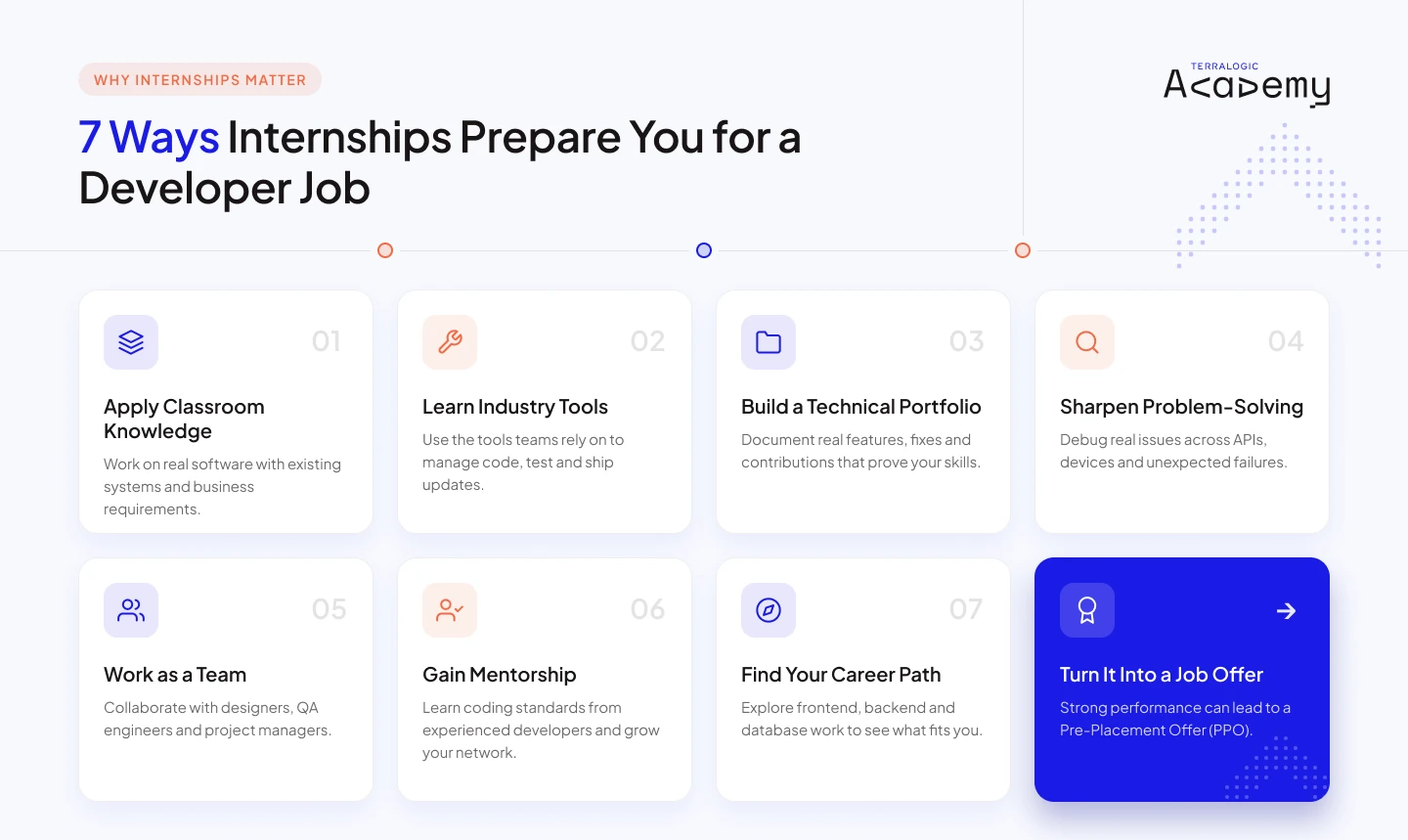
Internships help students develop technical competence, professional confidence, and a clearer understanding of industry expectations. Their value comes from applying knowledge in situations where code quality, collaboration, and delivery matter.
1. Apply Classroom Knowledge to Real Software Projects
College assignments generally focus on understanding programming concepts. Professional software development involves working with existing systems, identifying problems, and making changes without affecting other features.
Internships introduce students to these responsibilities.
For example, a student who has built a basic login application might be assigned to fix authentication errors, validate user inputs, or improve an existing login feature.
Such tasks develop hands-on coding experience while teaching students to understand unfamiliar code, test changes, and investigate errors.
2. Learn Industry-Standard Development Tools
Software development involves more than programming languages. Developers use tools to manage code, collaborate, test applications, and release updates.
During internships, students may gain experience with:
| Tool | What It’s Used For |
|---|---|
| Git and GitHub | Version control and collaborative development |
| Jira | Tracking tasks, bugs, and project progress |
| Docker | Running applications in consistent environments |
| AWS or Azure | Understanding cloud services and deployment |
| CI/CD pipelines | Automating software testing and delivery |
Students may also participate in code reviews and Agile development workflows.
Knowing how these tools fit into a development process helps students build industry-ready skills, although the specific tools vary between companies.
Build Industry-Ready Skills: Explore the Course →
3. Build a Strong Technical Portfolio
A resume can list programming languages, but a portfolio demonstrates how those skills have been applied.
Internships for software developers provide opportunities to document completed features, resolved issues, and technical contributions.
For example, an intern might:
- Develop an API endpoint for an application.
- Identify and resolve a database query issue.
- Write automated tests for an existing feature.
These contributions provide useful examples for technical interviews.
Students can strengthen their GitHub portfolio with approved code samples, personal projects, and clear documentation. Confidential company code should never be shared without permission.
4. Improve Problem-Solving and Debugging Skills
Professional development rarely involves solving perfectly defined problems.
An application might fail unexpectedly, an API might return incorrect information, or a feature might behave differently across devices.
Internships teach students to investigate such problems systematically.
Rather than immediately rewriting code, they learn to:
Reproduce Errors → Inspect Logs → Identify Causes → Test Solutions → Verify the Fix
These troubleshooting habits are valuable because employers need developers who can maintain software, not just create new applications.
5. Develop Communication and Teamwork Skills
Software developers frequently collaborate with designers, QA engineers, project managers, and other developers.
Internships help students understand how technical responsibilities connect with team objectives.
For example, a developer might need to explain why a feature requires additional testing or clarify a technical limitation to a project manager.
Participating in team discussions, reporting progress, and accepting code review feedback strengthens communication and professional accountability.
6. Gain Mentorship and Professional Connections
Working alongside experienced developers provides learning opportunities that independent study may not offer.
A mentor can help students understand coding standards, review technical decisions, and identify areas for improvement.
These relationships can also support future job searches through professional references, recommendations, or referrals.
However, referrals improve access to opportunities; they do not replace the technical assessments or interviews required by employers.
7. Identify the Right Software Development Career Path
Students may understand programming but remain uncertain about which development role suits them.
Internships provide exposure to different responsibilities, helping them evaluate whether they enjoy building interfaces, developing APIs, working with databases, or testing applications.
This experience can guide future learning decisions and help students choose a suitable specialization.
How Do Software Development Internships Improve Your Chances of Getting Hired?
Internships strengthen employability by giving employers evidence of a student’s ability to work in a professional environment.
Instead of assessing candidates only through academic scores and interview performance, recruiters can consider practical contributions, technical decisions, and workplace experience.
Internship Experience Makes Your Resume More Relevant
For students applying for software developer jobs as freshers, relevant project contributions can make a resume more informative.
A candidate who has completed an internship can explain which technologies they used, what responsibilities they handled, and how they solved technical problems.
This gives recruiters more context than a list of programming languages or course certificates alone.
Employers Can Evaluate Performance Before Hiring
An internship also allows companies to observe how candidates perform over time.
Employers can assess whether interns write maintainable code, complete assigned work, communicate effectively, and respond to feedback.
For students, this provides an opportunity to demonstrate professional readiness beyond a short technical interview.
Internships Can Lead to Pre-Placement Offers
A pre-placement offer (PPO) is an offer of full-time employment made to an eligible student before completing their academic programme, often following an internship or placement assessment.
India’s internship-to-employment pathway is receiving greater attention.
According to Deloitte India’s Campus Workforce Trends 2026, internship-to-PPO conversion rates improved by approximately 6% year over year across the degree categories covered by its research.
This reflects growing employer interest in internship-based recruitment, although it does not represent a guaranteed placement rate for software development students.
Whether an intern receives a PPO depends on performance, eligibility, available positions, and company hiring requirements.
FACT BREAKER: “An internship guarantees a job.” Not true. Internship completion does not automatically result in employment. A company may consider an intern for a PPO based on technical performance, professional behaviour, available vacancies, and its recruitment policies.
Academic Projects vs Internship Experience: What Is the Difference?
Academic projects and internships both help students develop software skills, but they provide different forms of experience.
| Academic Projects | Internship Experience |
|---|---|
| Focus on learning programming concepts | Focus on practical project requirements |
| Often involve smaller applications | May involve existing, complex codebases |
| Evaluated mainly through academic criteria | Evaluated through technical and delivery expectations |
| Usually involve students or instructors | May involve professional development teams |
| Demonstrate technical understanding | Demonstrate technical and workplace capabilities |
The key difference: Academic projects show what students can build, while internships can demonstrate how they contribute to software development in a professional environment.
Students who combine strong academic fundamentals with practical experience can present a more complete technical profile.
How Can Students Find Software Development Internships?
Students can improve their chances of securing internships by preparing for a specific development role, demonstrating relevant skills, and applying through credible channels.
| Step | What You’re Doing |
|---|---|
| 1. Choose a Development Specialization | Identifying the role you want to pursue |
| 2. Build Your Programming Fundamentals | Language, DSA, SQL, Git, APIs |
| 3. Create Projects and a Professional Resume | One or two functional projects, focused resume |
| 4. Apply Through Reliable Platforms | AICTE, Internshala, LinkedIn, placement cells |
| 5. Build Professional Connections | Alumni, engineers, recruiters, communities |
| 6. Prepare for Technical Interviews | Coding problems, explaining your projects |
Step 1: Choose a Development Specialization
Start by identifying the role you want to pursue.
For example, aspiring back-end developers might prioritize Java, Python, databases, and APIs, while front-end applicants may focus on JavaScript, HTML, CSS, and a relevant framework.
Choosing a direction makes technical preparation more focused.
Step 2: Build Your Programming Fundamentals
Before applying, develop a working understanding of:
- At least one relevant programming language.
- Data structures and algorithms.
- SQL and database fundamentals.
- Git and basic software debugging.
- APIs, frameworks, or testing tools relevant to the role.
You do not need to master every technology. You should be able to explain and apply the skills listed on your resume.
Step 3: Create Projects and a Professional Resume
Build one or two functional projects that demonstrate your capabilities.
Document the problem, technologies, important features, and development process.
Create a focused resume that includes relevant technical skills, academic projects, GitHub links, and achievements.
Build Real Projects With Mentor Support →
Step 4: Apply Through Reliable Platforms
Indian students can explore opportunities through:
- AICTE National Internship Portal
- Internshala
- LinkedIn Jobs
- College placement cells and official company career portals.
The AICTE National Internship Portal connects students with internship opportunities across different sectors and provides free student registration.
Look beyond company reputation. Check whether an internship provides relevant technical responsibilities, mentorship, clear expectations, and legitimate employment terms.
Step 5: Build Professional Connections
Connect with college alumni, software engineers, recruiters, and developer communities.
Ask specific questions about technologies, internship responsibilities, and application requirements.
Professional relationships can help students discover suitable opportunities and understand what employers expect.
Step 6: Prepare for Technical Interviews
Internship assessments may include programming questions, technical discussions, practical assignments, and behavioural interviews.
Prepare by practising relevant coding problems and learning to explain your projects clearly.
If you use AI coding assistants, understand the generated code, test it independently, and be prepared to explain your decisions.
How Can You Turn a Software Development Internship Into a Full-Time Job?
Completing an internship is useful, but the quality of your contributions determines how effectively you can use that experience when applying for jobs.
Follow these six practices to strengthen your internship-to-full-time-job pathway.
How Should You Present Internship Experience on Your Resume?
Effective resume descriptions explain what you built, which technologies you used, and what you contributed.
Avoid generic statements that provide little technical information.
| Weak Example | Stronger Example |
|---|---|
| “Worked on backend development during my internship.” | “Developed and tested REST API endpoints using Python and Flask, implemented request validation, and resolved defects identified during code reviews.” |
The second example is more useful because it communicates specific responsibilities and technical skills. It is illustrative; describe only work you actually performed.
During interviews, prepare to explain the problem, your approach, technical challenges, and the outcome.
Not Sure Where to Start? Talk to a Counsellor →
Can You Get a Software Developer Job Without an Internship?
Yes. Internships are valuable, but they are not mandatory for every entry-level software development role.
Students without internship experience can demonstrate their abilities through other practical work.
Relevant alternatives include:
- Building and deploying complete applications.
- Contributing to open-source development.
- Participating in technical hackathons.
- Completing supervised projects or legitimate freelance assignments.
- Maintaining documented GitHub repositories.
Employers may still assess academic qualifications, coding fundamentals, technical interviews, and role-specific capabilities.
The important objective is to demonstrate that you can apply programming knowledge to practical problems.
What Mistakes Should Students Avoid During Software Development Internships?
Students should focus on gaining useful experience rather than simply completing an internship requirement.
Five mistakes can reduce the value of an internship:
| Mistake | What to Do Instead |
|---|---|
| Prioritizing certificates over learning | Focus on meaningful tasks and technical progress |
| Copying code without understanding it | Explain, test, and verify your solutions, including AI-generated code |
| Avoiding feedback | Use code reviews to identify weaknesses and improve |
| Ignoring documentation | Record your contributions, technical decisions, and completed work |
| Overlooking professional relationships | Build respectful connections with mentors and teammates |
A shorter internship involving genuine development work can be more useful than a longer programme offering little technical exposure.
So, Do Internships Help You Get a Software Developer Job?
A software development career requires more than understanding programming concepts. Students must learn to apply those concepts, solve problems, communicate technical decisions, and collaborate with development teams.
Internships provide an opportunity to develop these capabilities while gaining exposure to professional software projects.
Whether an internship leads directly to employment or strengthens future applications, its value lies in the skills and experience students gain.
Build Skills That Employers Can Evaluate
Start with strong programming fundamentals, build practical projects, and pursue internships where you can contribute meaningful technical work.
Explore Software Development Programs →
Frequently Asked Questions
Are internships necessary to become a software developer?
No. Students can become software developers through academic projects, independent applications, open-source contributions, and technical assessments. However, relevant internships provide professional exposure and can strengthen applications for entry-level positions.
When should students start applying for software development internships?
Students can begin exploring internships once they have basic programming knowledge and relevant projects. Some programmes accept early-year students, while others require candidates to be in their pre-final year. Always review the specific eligibility criteria.
Can first-year students get software development internships?
Yes, some internship programmes accept first-year students. Beginners should focus on programming fundamentals, small functional projects, and opportunities designed for early-stage learners.
How long does a software development internship last?
Duration varies by employer and programme. Internships may last a few weeks, several months, or an academic semester. The AICTE National Internship Portal describes weekly, monthly, and semester-based formats. Relevant responsibilities and mentorship matter more than duration alone.
Do software development internships guarantee placement?
No. Internship completion does not automatically result in employment. A company may consider an intern for a PPO based on technical performance, professional behaviour, available vacancies, and its recruitment policies.
Keep learning: explore Terralogic Academy programs or browse more career guides on the Terralogic Academy blog.
All topics


