TL;DR
- To become a software developer, start by learning one programming language and essential computer science concepts.
- Then master development tools, build and deploy practical applications, and prepare for technical interviews.
- A practical software developer roadmap for students can be divided into four phases across roughly 9–12 months.
- A working, documented application demonstrates more than a tutorial certificate.
- Measure progress through completed projects, technical understanding, and independent problem-solving rather than the number of months spent learning.
Learning to code is one thing. Becoming a software developer who can solve real problems is another.
Many students learn programming languages, complete tutorials, and earn certifications. But when asked to build an application independently, they struggle to know where to begin.
The missing piece is often practical experience.
To become a software developer, you need more than coding knowledge. You need a structured learning path that connects programming fundamentals with real-world projects, development tools, and professional skills.
This guide explains how students can become software developers, from writing their first program to preparing for their first job.
Quick Answer: How Can a Student Become a Software Developer?
To become a software developer, start by learning one programming language and essential computer science concepts. Then master development tools, build and deploy practical applications, and prepare for technical interviews. Following a structured software developer roadmap helps you develop the skills and portfolio needed for entry-level opportunities.
What Does a Software Developer Do?
A software developer designs, builds, tests, and maintains applications that solve specific problems.
Think about a college attendance management application. A developer must understand the requirements, create the interface, organise student records, implement functionality, and ensure everything works correctly.
The role involves more than writing code.
Typical responsibilities include:
- Developing and maintaining applications.
- Debugging errors and testing functionality.
- Working with databases and APIs (Application Programming Interfaces).
- Improving application performance and security.
- Collaborating with designers, testers, and other developers.
Job titles such as software engineer, web developer, application developer, and programmer may involve overlapping responsibilities. Their exact scope depends on the company and position.
Which Software Development Career Path Should You Choose?
Not every developer works on the same technology.
Before selecting a specialisation, understand which type of software you want to build.
| Career Path | Essential Technologies | What You Build |
|---|---|---|
| Frontend Developer | HTML, CSS, JavaScript, React | Websites and user interfaces |
| Backend Developer | Python, Java, Node.js, SQL | APIs, server logic, and data systems |
| Full-Stack Developer | Frontend and backend technologies | Complete web applications |
| Mobile App Developer | Kotlin, Swift, Flutter | Android and iOS applications |
| AI/ML Developer | Python, ML libraries, APIs | AI-powered applications and systems |
Which Programming Language Should Beginners Learn First?
Choose a language based on your career interests.
| Language | Why Learn It |
|---|---|
| Python | A useful starting point for general programming, backend development, automation, and AI. |
| JavaScript | A strong choice for web development because it supports frontend and backend applications. |
| Java | Commonly used in enterprise applications and backend systems. |
| C++ | Useful for learning lower-level programming concepts and performance-focused development. |
You don’t need to learn all four. Start with one, understand its fundamentals, and expand when your chosen role requires it.
Step-by-Step Software Developer Roadmap for Students
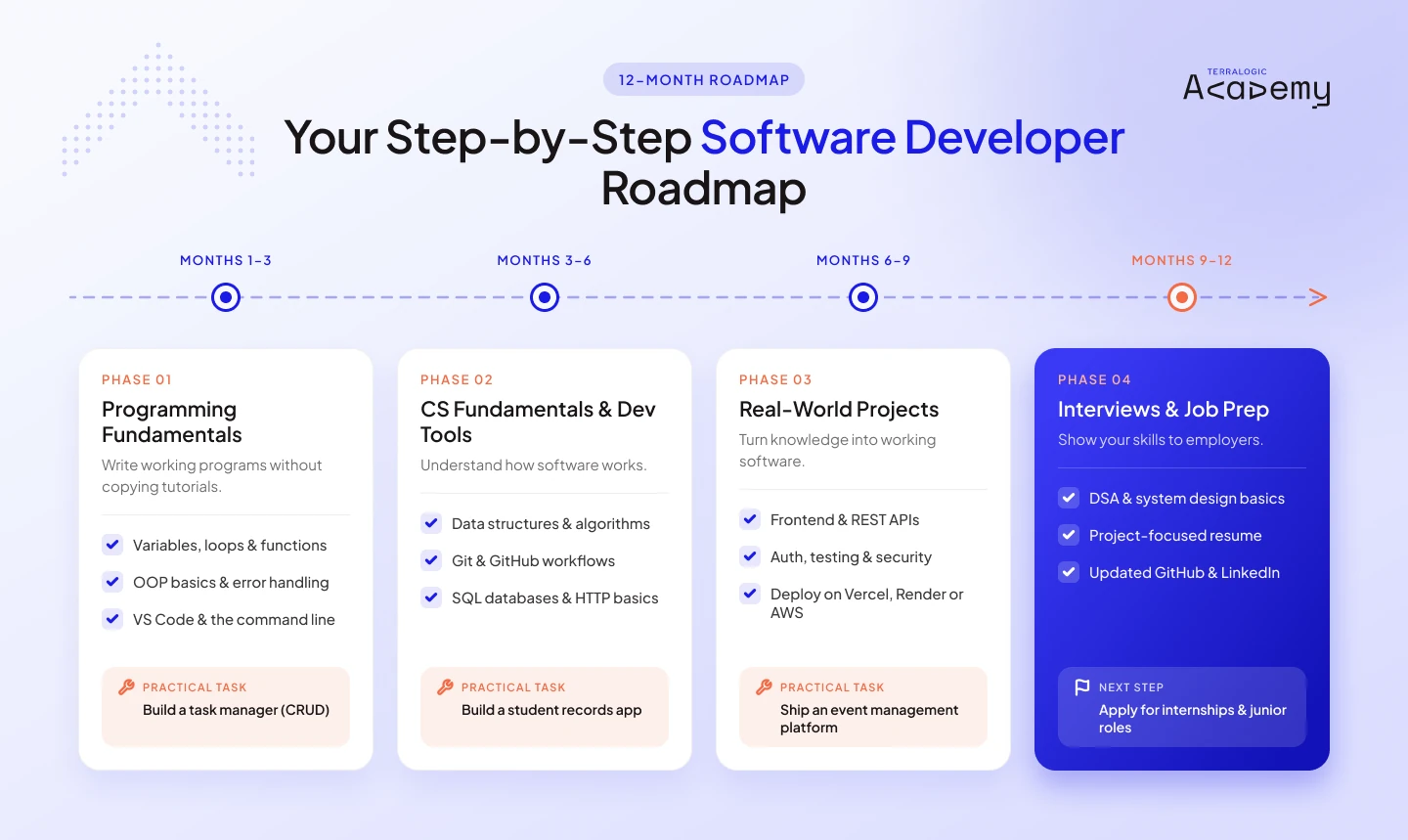
A practical software developer roadmap for students can be divided into four phases.
| Phase | Suggested Timeline | Main Objective |
|---|---|---|
| 1. Programming fundamentals | Months 1–3 | Learn to code independently |
| 2. Computer science and tools | Months 3–6 | Strengthen technical foundations |
| 3. Projects and deployment | Months 6–9 | Build real applications |
| 4. Interview and career preparation | Months 9–12 | Prepare for entry-level opportunities |
These timelines are illustrative. Your progress depends on previous experience, study hours, and practical learning.
Phase 1: Master Programming Fundamentals (Months 1–3)
Goal: Write working programs without copying tutorials.
Your first three months should focus on learning how programming works, not memorising syntax.
Start with:
- Variables, data types, and operators.
- Conditional statements and loops.
- Functions, arrays, and lists.
- Basic object-oriented programming (OOP).
- Input validation and error handling.
Set up Visual Studio Code (VS Code) and practise using the command line to run programs.
Practical task: Build a simple task manager where users can create, view, update, and delete tasks. These are called CRUD operations.
Milestone: Can you create the application from a blank file and explain how every feature works?
If you can, you’re developing independent problem-solving ability.
Phase 2: Learn Computer Science Fundamentals and Developer Tools (Months 3–6)
Goal: Understand how software works and develop stronger problem-solving skills.
Knowing a programming language is useful. Understanding how to structure, manage, and improve programs makes that knowledge more valuable.
Focus on four areas.
1. Data Structures and Algorithms (DSA)
Learn arrays, strings, stacks, queues, linked lists, hash maps, searching, sorting, and introductory time complexity.
Practise problems on LeetCode or HackerRank. Begin with simple problems and gradually increase difficulty.
2. Version Control
Learn Git to track code changes and GitHub to store repositories and collaborate.
Practise commits, branches, merges, and pull requests.
3. Database Management
Understand SQL, tables, relationships, and queries using PostgreSQL or MySQL. Explore MongoDB when your projects need a document-oriented database.
4. Core Computer Science
Learn essential concepts in operating systems, networking, HTTP, and client-server communication.
Practical task: Create a student record management application with database storage.
Milestone: You should be able to retrieve records using SQL, explain your data structures, and manage project versions using Git.
Start Your Developer Journey: Explore the Course →
Phase 3: Build Real-World Projects and Deploy Applications (Months 6–9)
Goal: Turn technical knowledge into working software.
This is where your software development skills become visible.
Suppose you’re building a college event management platform.
The application should allow students to browse events, register, and view their bookings. Administrators should be able to manage event information.
To develop it, you’ll need to understand:
- Frontend interfaces and user interaction.
- Backend logic and REST APIs.
- Database integration.
- User authentication and input validation.
- Testing, debugging, and error handling.
- Basic application security.
For a web application, you might use React, Node.js, Express, and PostgreSQL or MongoDB. The technology stack should match your project requirements.
Once the application works locally, deploy it using an appropriate platform such as Vercel, Render, or AWS.
Maintain a GitHub repository containing the source code, setup instructions, project features, and screenshots.
Milestone: Can someone access your application, use its main features, and understand how you built it?
A working, documented application demonstrates more than a tutorial certificate.
Phase 4: Prepare for Technical Interviews and Jobs (Months 9–12)
Goal: Demonstrate your skills to potential employers.
Start preparing for interviews while continuing to improve your projects.
Prioritise:
- DSA practice: Revise fundamental concepts and solve problems relevant to your target positions.
- System design basics: Understand client-server architecture, caching, and how applications handle requests.
- Technical communication: Practise explaining your solutions and development decisions.
- Resume building: Highlight relevant skills, projects, internships, and measurable outcomes.
- Professional profiles: Keep GitHub and LinkedIn updated with your strongest work.
For example, an interviewer may ask why you selected a particular database or how you handled invalid user inputs.
Your answer should explain the problem, your decision, and the result.
Milestone: Can you solve relevant coding problems and confidently explain your own application architecture?
Start applying for suitable internships and junior roles before this phase ends. You don’t need to master every advanced topic before gaining professional experience.
What Projects Should Students Build to Become Software Developers?
Your portfolio should demonstrate progress from basic programming to practical application development.
| Level | Project Idea | Skills Demonstrated |
|---|---|---|
| Beginner | Task manager | Programming logic, CRUD operations |
| Intermediate | Expense tracker | Database operations, validation, application structure |
| Advanced | College event management system | Authentication, APIs, testing, deployment |
Here’s a useful approach: improve one application across multiple learning stages.
Local File → Database → Web Interface → Authentication → Deploy
First, build a task manager using a local file. Next, connect it to a database. Finally, develop a web interface, introduce authentication, and deploy it.
This progression shows how you approach increasingly complex engineering problems.
What Makes a Software Development Project Portfolio-Ready?
Before showcasing a project, check whether it has:
- A clear problem statement and working features.
- Organised, readable source code.
- A GitHub README explaining setup and functionality.
- Screenshots or a live demonstration.
- Basic tests, error handling, and documentation.
Quality matters more than quantity. Two well-developed applications can demonstrate your ability more effectively than numerous unfinished projects.
Build Portfolio Projects With Mentor Support →
How Should Students Use AI Tools While Learning Software Development?
AI coding assistants can support your learning, but they cannot replace your understanding of programming.
The Stack Overflow Developer Survey 2026 found that 48% of respondents trust AI-generated output when they can easily verify it.
That distinction matters for students.
Use tools such as ChatGPT, Claude, and GitHub Copilot to explain concepts, identify possible errors, suggest tests, and review implementations.
However, always run the code, understand its behaviour, and check its security implications.
A PRACTICAL RULE: If you cannot explain why an AI-generated solution works, don’t treat it as a completed learning milestone.
How Can College Students Prepare Before Graduation?
You don’t have to wait until your final semester to begin a coding career.
| College Year | Recommended Learning Focus |
|---|---|
| First year | Programming fundamentals and small coding exercises |
| Second year | DSA, databases, Git, and choosing a specialisation |
| Third year | Portfolio projects, internships, and collaboration |
| Final year | Major projects, technical interviews, and job applications |
Starting early provides more opportunities to practise, but this isn’t a fixed schedule. Students beginning in their final year can prioritise foundational skills and build focused projects alongside interview preparation.
Where Can Students Learn Software Development?
You can combine structured courses, official documentation, and practical exercises.
Useful resources include:
| Resource | What It Covers |
|---|---|
| Harvard CS50 | Computer science fundamentals |
| freeCodeCamp | Interactive programming and web development lessons |
| MDN Web Docs | Web technologies and development practices |
| roadmap.sh | Role-specific technology learning paths |
| GitHub Docs | Version control and collaboration workflows |
| LeetCode | Coding interview practice |
Choose resources that align with your developer career path. Complete exercises independently before advancing to more complicated tools.
How Can Freshers Get Their First Software Developer Job?
Your software development career path for freshers should focus on demonstrating skills, gaining experience, and applying strategically.
1. Build a Project-Focused Resume
Include your programming languages, technical tools, relevant education, and strongest projects.
Instead of writing “Knowledge of SQL and React,” describe what you built using those technologies.
2. Gain Practical Experience
Look for internships, hackathons, open-source contributions, and beginner-friendly collaborative projects.
These opportunities help you understand requirements, deadlines, code reviews, and teamwork.
3. Apply Through Relevant Channels
Explore company career pages, campus placements, LinkedIn, Naukri, Internshala, and professional communities.
Read each job description carefully and prioritise roles matching your current skills.
4. Prepare for Interview Rounds
Depending on the company, you may encounter coding assessments, technical interviews, project discussions, and HR rounds.
Prepare to explain your code, identify mistakes, and discuss alternative approaches.
Not Sure Where to Start? Talk to a Counsellor →
How Long Does It Take to Become a Software Developer?
There is no fixed timeline for how to become a software developer from scratch.
A structured 9–12-month plan can provide a useful learning framework, but employment readiness depends on your starting knowledge, consistency, chosen specialisation, and the roles you’re targeting.
Students learning for 5–7 hours weekly may need more time than those studying for 15–20 hours.
Measure progress through completed projects, technical understanding, and independent problem-solving rather than the number of months spent learning.
FACT BREAKER: “I need to master every advanced topic before applying.” Not true. Start applying for suitable internships and junior roles before your final phase ends. Software development involves continuous learning, and you don’t need to know every framework before starting your career.
What Mistakes Should Aspiring Software Developers Avoid?
Several learning habits can slow your progress.
Remember that software development involves continuous learning. You don’t need to know every framework before starting your career.
Final Take: Start Building Your Software Development Career
Becoming a software developer isn’t about collecting programming languages or completing endless tutorials. It’s about learning to solve problems and building applications that work.
Start with one language. Strengthen your fundamentals, learn developer tools, build meaningful projects, and develop the confidence to explain your work.
If you prefer structured, project-based learning with industry guidance, explore the Full Stack Web Development Course at Terralogic Academy.
Your next step is simple: choose a programming language and build your first application.
Explore the Full Stack Web Development Course →
Frequently Asked Questions
Can I Become a Software Developer Without a Computer Science Degree?
Yes. Some employers consider candidates with relevant programming skills, projects, and practical experience without requiring a computer science degree. However, specific educational requirements vary by company and position.
Can Non-IT Students Become Software Developers?
Yes. Students from non-IT backgrounds can learn programming, computer science fundamentals, and development tools. A structured learning plan and practical projects can help demonstrate technical ability.
Is Python or Java Better for Beginner Software Developers?
Python has approachable syntax and is useful for automation, backend development, and AI. Java is widely used for enterprise applications. Choose according to your preferred specialisation and target job requirements.
Is DSA Necessary to Become a Software Developer?
Understanding DSA helps you write efficient programs and solve technical problems. Many employers assess these skills during interviews, although the expected difficulty varies by role.
Do Software Developers Need Full-Stack Development Skills?
No. Frontend, backend, mobile, and other development roles have different requirements. Full-stack knowledge is useful when you want to work across an application’s frontend and backend.
Keep learning: explore the Terralogic Academy Full Stack Web Development Course or browse more career guides on the Terralogic Academy blog.
All topics


